

Alexandrine Parakeet
Species
Psittacula eupatria
Order
Psittaciformes
Family
Psittaculidae
Conservation status
Near Threatened (NT)
The Alexandrine parakeet (Psittacula eupatria) is native to South Asia, found in countries such as Afghanistan, Pakistan, India, Sri Lanka, Myanmar, Thailand, Laos, Cambodia, and Vietnam. Thanks to its adaptability, it has also established populations in urban and rural areas outside its natural range, including parts of Europe and the Middle East.
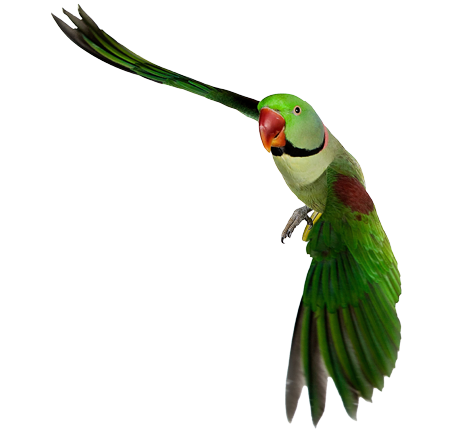

The Alexandrine parakeet (Psittacula eupatria) measures 48 to 62 cm in length, making it significantly larger than other parakeets of the genus Psittacula, and weighs between 200 and 300 g.
Its plumage is mainly green, with a black collar on the front of the neck and a pinkish band at the back. On the shoulders, it has a maroon-red patch. The tail feathers are blue, green, and yellow at the tips, while the most striking feature is its bright red beak. The eyes are pale yellow, and the legs are greenish-gray. The female looks similar to the male but can be distinguished by the absence of the neck collar.
In captivity, Alexandrine parakeets can live up to 30 years under proper human care.
Its distribution ranges from Afghanistan and Pakistan, across India, Myanmar, and Thailand, to Laos, Cambodia, and Vietnam. It has also colonized Sri Lanka and the Andaman Islands. Its natural habitat includes subtropical dry forests, mangroves, scrublands, and desert ecosystems, but it also adapts well to urban and suburban environments.
Its diet is herbivorous, consisting of wild and cultivated seeds, fruits, nuts, shoots, flowers, and nectar. Occasionally, it may cause damage to crops such as corn and rice.
It generally lives in pairs or small groups, although it may form larger flocks in areas with abundant food. It is a highly vocal species, with loud and varied calls.
The breeding season runs from November to April within its natural range. The female lays two to four eggs, which she incubates alone while being fed by the male. The eggs hatch after 20 to 25 days, and the chicks are fed by both parents, leaving the nest at around six weeks of age.
The common name of the species, “Alexandrine”, commemorates Alexander the Great, who is credited with exporting numerous specimens of this parakeet from Punjab to various countries in Europe and the Mediterranean regions.
Under human care, the Alexandrine parakeet can learn to imitate words and human sounds, although its ability is not as developed as that of some other parrot species.
Although in the wild they display predominantly green plumage, under human care color variants have been developed, including yellow, blue, and white individuals, through selective breeding.
There are five recognized subspecies, mainly distinguished by their geographic distribution and slight variations in plumage:
Psittacula eupatria eupatria
Psittacula eupatria nipalensis
Psittacula eupatria avensis
Psittacula eupatria magnirostris
Psittacula eupatria siamensis