

Low risk (Least concern)
Blue-and-yellow Macaw
Species
Ara ararauna
Order
Psittaciformes
Family
Psittacidae
Conservation status
Macaws are a genus of birds belonging to the parrot family (Psittacidae), within the order Psittaciformes. They include 14 species (six of them extinct) of American origin, inhabiting areas from the jungles of Mexico to northeastern Argentina, approximately. They feed on insects and berries and live in trees.
A total of 17 species of macaws are recognized (23 if the extinct ones are included), divided into 6 genera, with Ara being the most numerous (originally, this genus included all other species, and in some books and references it still appears as the sole genus).

Characteristics
Behavior, Diet, and Habitat
Interesting Facts
Characteristics
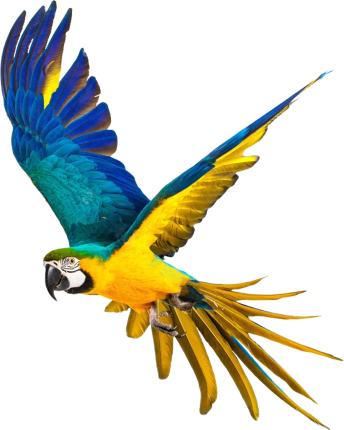
The blue-and-yellow macaw, also known as the blue-and-gold macaw or blue guard macaw, is an impressive and colorful parrot, representative of the macaw family. Blue-and-yellow macaws measure between 81 and 91.5 cm in length, weigh 0.9 to 1.8 kg, and have a wingspan of 104 to 114 cm. They display vibrant colors, with blue backs and wings, yellow underparts, green feathers on the forehead, and green wing tips. The undersides of the wings and the chest are orange-yellow, and they have black beaks, throats, and legs. Their eyes are yellow, and the facial area is composed of bare white skin with several lines of small black feathers around the eyes. In addition, these macaws have a considerably long lifespan, living between 30 and 50 years, and sometimes even longer in captivity.
These macaws have an extremely strong, curved beak designed to break the hard shells of nuts and seeds that make up much of their diet. Their claws are strong and agile, enabling them to climb and handle objects with great dexterity. Their plumage is not only bright and striking but also serves a protective function, providing camouflage in their natural tropical forest habitats.
The blue-and-yellow macaw has well-developed chest muscles, which allow it to perform long and sustained flights, essential for foraging and migrating between habitats. The structure of its feathers gives them optimal aerodynamics, enabling them to maneuver quickly among trees and perform acrobatic flights. Their vocal mimicry is also remarkable, and in captivity, they can learn to repeat human words and phrases, which contributes to their popularity as pets.
Behavior, Diet, and Habitat
The blue-and-yellow macaw (Ara ararauna) is a truly South American macaw: its range extends from Panama to northern Argentina, covering the entire Amazon basin. In captivity, they reproduce easily; in the wild, they live in groups of 25–30 individuals. They have been known as pet birds since Columbus’s first voyage back to Spain after the discovery of the Americas. They breed well in captivity, and since 1935 they have reproduced under artificial conditions with relative ease. They do not have a defined breeding season and can reproduce throughout the year, although activity peaks in late spring.
Blue-and-yellow macaws are most often found in pairs, but they may gather in groups to form flocks. In pairs, they fly very close together, almost touching wings. When foraging, they may join small, noisy flocks early in the morning, but by midday they begin seeking shade. They feed mainly on seeds, nuts, and fruits, using their powerful beaks to crack nuts and crush seeds.
They are found primarily in tropical rainforests, particularly in swampy and riverine areas. They nest high in trees to avoid predation. In addition, these macaws also inhabit open areas and secondary forests, showing remarkable adaptability to different habitats. They prefer nesting in cavities of tall trees, where they are safer from predators and have easy access to food sources.
In their natural environment, blue-and-yellow macaws play a crucial role in seed dispersal, helping maintain the biodiversity of tropical forests. While foraging, their varied diet allows them to adapt to different seasons, consuming what is available—ripe fruits, hard seeds, and occasionally flowers and leaves.
Interesting Facts
They make very good pets, with a strong ability to imitate the human voice, but they require daily attention from their owners or they may become prone to depression and feather plucking. They need large cages where they can stretch their wings, as well as toys and space for exercise. These requirements are common to almost all parrots. Known predators include the harpy eagle (Harpia harpyja), the changeable hawk-eagle (Nisaetus cirrhatus), and the orange-breasted falcon (Falco deiroleucus), which attack while the birds are in flight. Humans are also predators, as they hunt these macaws for the pet trade, food, and feathers.
In addition, blue-and-yellow macaws have a remarkable capacity to form close bonds not only with their mates but also with humans, showing affectionate and loyal behaviors. In captivity, they can develop complex behaviors and require constant mental and physical stimulation to remain healthy and happy. Their intelligence and inquisitive nature make them prone to exploring their surroundings and learning new skills.
In the wild, blue-and-yellow macaws use a wide range of complex vocalizations to communicate with their mates and group members. These calls may include alarm cries, feeding signals, and sounds that maintain group cohesion. They are also known for their problem-solving abilities, such as finding new food sources or protecting their nests from predators.
Conservation programs have been essential in protecting blue-and-yellow macaws from poaching and habitat loss. In several regions, initiatives have been implemented to preserve their natural habitats and encourage captive breeding as a way of reintroducing them into the wild. Public education on the importance of these birds and the banning of illegal trade have also contributed to their protection.
