

Low risk (Least concern)
Blue-crowned Parakeet
Species
Thectocercus acuticaudatus
Order
Psittaciformes
Family
Psittacidae
Conservation status
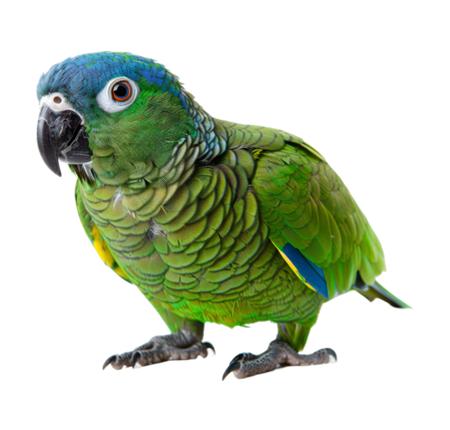
The Blue-crowned Parakeet or Blue-crowned Conure (Aratinga acuticaudata) is a member of the genus Aratinga widely distributed throughout South America. Its range extends from northern Argentina to southeastern Colombia.

Characteristics
Characteristics Behavior, Diet, and Habitat
Interesting Facts
Characteristics
Blue-crowned Parakeets are medium-sized parrots, averaging about 33 cm in length. They have predominantly green plumage, with the underparts and cheeks a bright yellow color. They display a red patch on the forehead and some red feathers on the wings and tail. Their beak is short and strong, adapted to feed on a variety of foods. The upper mandible is marked with grayish-black speckles in adults, while the lower mandible shows this coloration in juveniles, becoming grayish-black by the second year of life. In addition, these parrots have large eyes with a white eye ring, giving them excellent vision for detecting food and predators. Their legs are strong and well-adapted for climbing and gripping branches with ease.
Blue-crowned Parakeets also possess remarkable vocal ability, using a wide range of sounds and calls to communicate with one another, which is especially important for maintaining group cohesion in the wild. Their long, pointed wings allow them to perform swift, agile flights through forest habitats.
Their green plumage provides excellent camouflage among the foliage, protecting them from potential predators. The vibrant coloration of their red and yellow patches is not only distinctive of the species but may also play a role in courtship and visual communication between individuals. These parrots also have a highly developed social behavior, forming noisy and active flocks that may include dozens of individuals.
The structure of their beak not only enables them to crack hard seeds and nuts but also serves as an essential tool for manipulating objects and building nests. Their ability to climb and handle objects with both beak and feet is indicative of their intelligence and adaptability in finding food and shelter. Furthermore, Blue-crowned Parakeets go through an annual molt, gradually replacing their feathers to keep their plumage in optimal condition.
Characteristics Behavior, Diet, and Habitat
Blue-crowned Parakeets are social and very active birds. They usually live in pairs or small family groups and are known for being noisy and vocal, especially in the morning and evening. They enjoy playing and climbing and are naturally quite curious. Their diet consists mainly of fruits, seeds, nuts, flowers, and buds. They may also feed on insects and their larvae, particularly during the breeding season. In captivity, they can be provided with a varied diet that includes fresh vegetables and parrot-formulated pellets to ensure they receive all necessary nutrients.
The natural habitat of the Blue-crowned Parakeet (Psittacara acuticaudatus) covers a variety of environments in South America. These birds can be found in tropical and subtropical forests, both humid and dry, where they have access to a wide range of trees and dense vegetation for nesting and foraging. They also inhabit savannas and shrublands, feeding on seeds, fruits, and other available resources. In some regions, they are found near water sources such as rivers, streams, and wetlands, and they can also adapt to urban and suburban environments, including parks, gardens, and residential areas, where they find food and shelter in trees and buildings. Moreover, their adaptability to different habitats allows them to thrive in a wide range of settings, from coastal areas to mountainous regions.
Interesting Facts
The upper mandible is marked with dark grayish spots in adults, while the lower mandible shows this coloration in juveniles, becoming dark gray by the second year of life. They form monogamous pairs and nest in tree cavities or rock crevices. The female usually lays between 3 and 5 eggs, which are incubated by both parents for approximately 23 to 25 days.
These parrots are known for their intelligence and ability to learn tricks and words in captivity. In addition, due to their curious nature, they often explore their surroundings and manipulate objects with their beaks and feet. In popular culture, Blue-crowned Parakeets are valued for their beauty and lively behavior, making them popular pets in many households.