

Eurasian Eagle-Owl
Species
Bubo bubo
Order
Strigiformes
Family
Strigidae
Conservation status
Least Concern (LC)
Bubo bubo is the scientific name of the Eurasian Eagle-Owl, a large and majestic owl species found across various regions of Europe, Asia, and North Africa.
The Eurasian Eagle-Owl has a broad distribution, ranging from Europe to Asia and parts of North Africa. It inhabits a variety of environments, including forests, rocky cliffs, steppes, and mountainous areas.
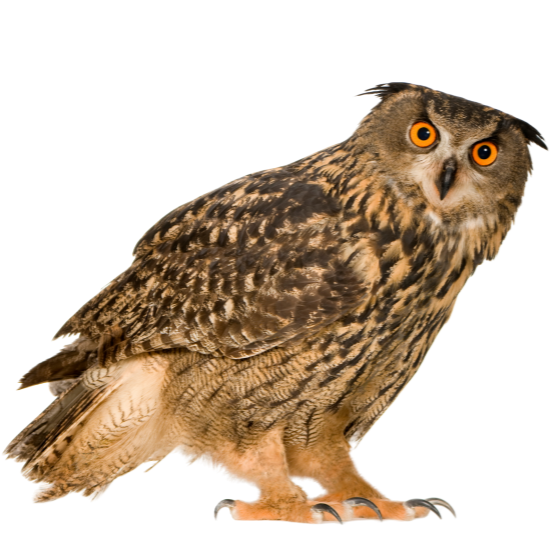

It is one of the largest owls in the world, with a wingspan that can reach up to 1.5 metres in some populations. It has dark brown plumage with lighter spots and streaks on the chest and belly. Its large yellow eyes are surrounded by a dark-feathered facial disc.
They are primarily nocturnal birds, hunting at night and resting during the day in sheltered areas. They possess excellent vision and hearing, which allow them to locate prey in the dark.
The Eurasian Eagle-Owl is a formidable predator that feeds mainly on small mammals such as rodents, rabbits, and hares. It can also hunt birds, reptiles, and even insects when necessary.
The habitat of the Eurasian Eagle-Owl (Bubo bubo) varies depending on the geographical region. However, they generally prefer open and mixed habitats that offer a combination of wooded areas, rocky outcrops, and grasslands.
- Impressive size: The Eurasian Eagle-Owl is the largest nocturnal bird of prey in the world, with a wingspan that can reach up to 1.5 metres in some populations. Its impressive size makes it a formidable predator within its ecosystem.
- Excellent vision and hearing: Eurasian Eagle-Owls have exceptional eyesight and hearing, allowing them to hunt efficiently in the dark. Their large orange eyes can see in low-light conditions, while their acute hearing enables them to detect prey from kilometres away.
- Silent flight: These birds have silent flight thanks to the special structure of their feathers. This enables them to approach their prey stealthily without being detected, increasing their chances of a successful catch.
- Cultural symbol: The Eurasian Eagle-Owl has been a cultural symbol in many societies throughout history. In Greek mythology, for example, the owl was associated with Athena, the goddess of wisdom. In some Native American cultures, the owl was considered a messenger between humans and the spiritual world.
- Apex predator: As a top predator in its ecosystem, the Eurasian Eagle-Owl plays an important role in controlling populations of rodents and other small animals. Its presence helps maintain ecological balance in the habitats it occupies.
