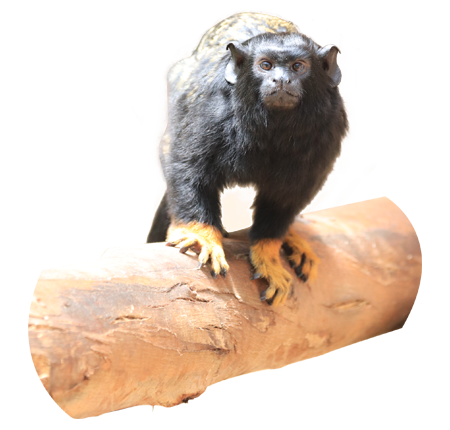
Golden-handed tamarins are small South American primates weighing around 500 g. They are characterized by the golden color of their hands and feet, which stand out against their dark fur. Their tail measures about 39 cm, is not prehensile, and is mainly used for balance.
The gestation period ranges from 140 to 170 days, with births usually resulting in 2 offspring, although they can have up to 3. Only the dominant female reproduces, but all members of the group participate in caring for the young.
They inhabit the rainforests of Brazil, Guyana, French Guiana, and Suriname, living in the treetops in small family groups of about 4–6 individuals.
This is a diurnal species, mostly arboreal in behavior, and they like to move through the trees at heights of around 10–20 meters. In terms of vocal communication, they use various high-pitched sounds, some of which are almost imperceptible to humans. To strengthen family bonds, they engage in grooming.
They are omnivores, feeding mainly on fruits, vegetables, and insects. Nearly 50% of their diet consists of insects.
It is said that their scientific name comes from King Midas of Greek mythology, who turned everything he touched into gold—hence the association with the golden color of their hands and feet.
The color of the hands and feet can vary between yellow and orange, depending on the geographical region. Some authors consider there to be two subspecies.