

Low risk
Species
Ara chioropterus
Order
Psittaciformes
Family
Psittacidae
Conservation status
Macaws are a genus of birds in the parrot family (Psittacidae), within the order Psittaciformes, comprising 14 species (six of them extinct) of American origin, inhabiting regions from the jungles of Mexico to northeastern Argentina. They feed on insects and berries and live in trees.
A total of 17 macaw species are recognized (23 if extinct ones are included), divided into 6 genera, with Ara being the most numerous (originally, this genus contained all the other species, and in some books and sources it still appears as the only genus).

Characteristics
Behavior, Diet, and Habitat
Interesting Facts
Characteristics
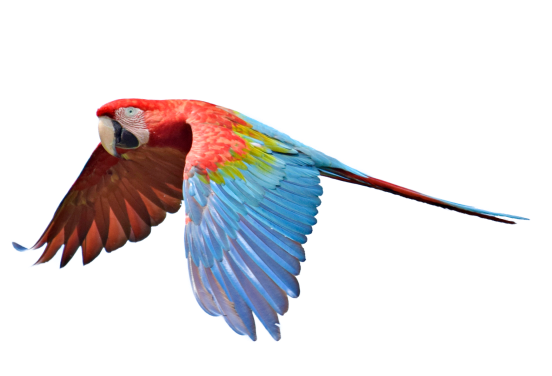
They are large macaws that draw attention with their vivid and spectacular coloration, as well as their loud calls used to communicate while in flight. Juveniles resemble adults but have shorter tails. Macaws have bright plumage that includes shades of blue, green, yellow, and red, depending on the specific species. They possess large, powerful beaks capable of cracking the hard shells of nuts and seeds. Their eyes are surrounded by a bare, white patch of skin, which can show slight changes in coloration depending on their mood.
The Great Green Macaw, specifically, is distinguished by its predominantly green wings and the bright red underside of its flight feathers. The top of its head and nape are a brilliant blue, which contrasts with the rest of its plumage. Its legs are strong and gray, with sharp claws that allow it to grip branches firmly and climb with ease.
These macaws are known for their intelligence and learning ability, being capable of performing a variety of tricks and imitating human sounds. They also have a long lifespan, which can exceed 60 years in captivity.
Great Green Macaws also have a highly developed social structure and form lifelong pair bonds. Their social behavior includes mutual preening, which helps strengthen bonds between individuals. They are very vocal birds, using a wide range of sounds to communicate with their mates and to alert others of predators.
Their wingspan can be quite impressive, reaching up to 120 cm, allowing them to perform long and sustained flights in search of food. Great Green Macaws also play a crucial role in the ecology of their habitat, aiding in seed dispersal and the regeneration of tropical forests.
They are large macaws that stand out for their vivid and spectacular coloration, as well as their loud calls used to communicate during flight. Juveniles resemble adults but have shorter tails. Macaws feature bright plumage that includes shades of blue, green, yellow, and red depending on the species. They have large, strong beaks designed to crack the hard shells of nuts and seeds. Their eyes are surrounded by a bare white area of skin, which can change slightly in color according to their mood.
Behavior, Diet, and Habitat
They are generally found in pairs or in small groups, often family groups; at times they associate with other macaws, especially on the ground, where they gather in large flocks to consume exposed mineral-rich clay. They feed on seeds, fruits, and nuts. These macaws are highly social and form strong bonds with their mates and group members. In the wild, they inhabit tropical and subtropical forests of Central and South America, preferring areas with abundant vegetation and access to water sources. Macaws are also known for their ability to travel long distances in search of food.
When kept as companion animals, they are intelligent and inquisitive birds but are perhaps, of all the large macaws, the least tolerant of solitude. For this reason, it is recommended that they live with another bird, which does not necessarily need to be of the same species. Their large size and high activity levels mean they require spacious cages and room to move. In captivity, they must be provided with a balanced diet that includes fresh fruits, vegetables, nuts, and formulated macaw pellets. They also need plenty of time outside the cage to fly and explore.
Interesting Facts
ChatGPT Plus
Breeding them in captivity is more challenging than with other large macaws. Despite these difficulties, macaws in captivity can live for many years, reaching a lifespan of 50 to 70 years with proper care. They are known for their ability to mimic sounds and words, which makes them popular talking pets. In addition, they have excellent memory and can learn to perform a variety of tricks and commands. Regular interaction and environmental enrichment are crucial to maintaining their mental and emotional well-being. In the wild, some macaws have been observed displaying unique behaviors, such as using rudimentary tools to access hard-to-reach food sources.


