

Great Horned Owl
Species
Bubo virginianus
Order
Strigiformes
Family
Strigidae
Conservation status
Low risk (Least Concern)
Great horned owls are characterized by a round facial structure, forward-facing eyes that allow for binocular vision, and feather tufts shaped like horns that enhance their camouflage. They have plumage in various shades of white, brown, and black, along with a distinctive white patch on the throat. Their size varies depending on location and sex, showing reverse sexual dimorphism, with females being larger than males.
This difference does not appear to be influenced by environmental factors, as they do not migrate far enough to interbreed with different subspecies. In colder regions, they are larger, following Bergmann’s rule, and they also exhibit color variations depending on the habitat they occupy.
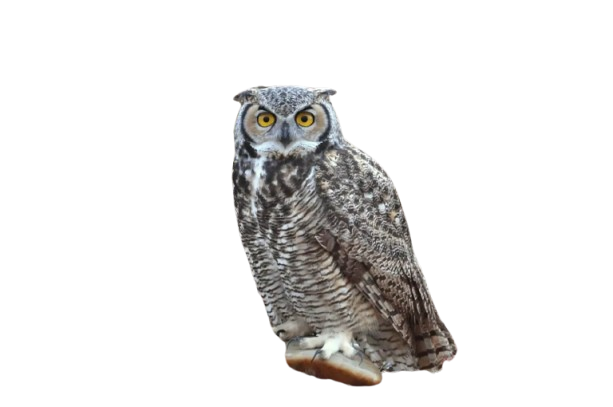

Like other similar owl species, great horned owls have a rounded facial structure and forward-facing eyes that allow for binocular vision. They feature distinctive feather tufts shaped like horns on the top of their heads, which are usually darker than the rest of the head, enhancing their camouflage. They also have a characteristic white patch on the throat. The belly is white with brown and black “bars” spread across the surface. Around their black beak, they are white or tan in color. The back is darker, with black and brown markings. Their eyes come in various shades of yellow.
The size of great horned owls varies depending on their geographic location and sex. They exhibit reverse sexual dimorphism, with females being slightly larger than males. Females weigh on average 1.7 kg, while males average 1.3 kg. Evidence suggests that this dimorphism is not influenced by environmental factors, based on the observation that great horned owls do not typically migrate long enough distances to interbreed with subspecies that may differ in size.
In northern latitudes, they tend to have larger body cores and greater wingspans. Their total length ranges from 45.7 to 63.5 cm, and their wingspan ranges from 127 to 152.4 cm. This is consistent with Bergmann’s rule, which states that in widely distributed genera, larger individuals tend to occur in northern latitudes, while smaller ones are found in southern regions. Color variations also occur depending on geographic location.
Great horned owls are not considered a social species and are solitary except during the nesting season. They do not migrate, but instead remain in the same area year-round. Great horned owls communicate with each other through calls, primarily to establish territorial boundaries. These territorial disputes can sometimes be fatal. Some individuals become what are known as “floating territorials” — they do not maintain a fixed territory and may move between the territories of other great horned owls. This behavior may be due to social pressures preventing reproduction. It can increase the reproductive success of those that do breed, while also preventing younger owls from reproducing too early, when their chances of success are lower.
Great horned owls are carnivores that primarily feed on terrestrial vertebrates. Their diet varies depending on prey availability. In late-succession areas, they feed on lagomorphs and voles. In the southwestern United States, where individuals are generally smaller, they often feed on smaller prey such as young rabbits, small rodents, or insects. In fields and deserts, their main diet likely consists of rodents and insects. In habitats near or surrounded by water, they are capable of hunting fish, amphibians, crustaceans, and reptiles. When hunting, they perch and watch for prey, then dive to capture it, even seizing it in mid-air if necessary.
Great horned owls are highly adaptable to a wide range of habitats and environments. They live at elevations ranging from sea level to 3,352.8 meters (11,000 feet). They are commonly found in areas that combine woodlands and open fields. Their habitats include grasslands, deserts, swamps, marshes, mangroves, and human settlements, both rural and urban.
Great horned owls are monogamous, forming mating pairs that raise their young together. Breeding pairs are territorial, excluding other breeding pairs from their territory to ensure access to prey. However, they only display territorial behavior in the areas near their nest and do not defend their territory entirely. Pairs bond through hooting rituals, which increase in intensity as the breeding season approaches. Males hoot year-round, but females only hoot during estrus.
Great horned owls nest in abandoned nests made by squirrels or other birds, including other great horned owls. Clutch size depends on food availability and geographic location. Smaller clutches are more common in years with fewer prey. On the eastern coast, clutches of more than two eggs are considered rare. In central and western North America, however, clutches of 3 to 4 eggs are not uncommon. They lay 1 to 6 eggs per season, which hatch after 30 to 37 days. The chicks leave the nest between 6 and 9 weeks and become independent between 5 and 10 weeks. They reach sexual maturity between 1 and 3 years of age. Like other birds with a wide geographic range, great horned owls tend to nest later in the year as latitude increases.
The average lifespan of great horned owls is 13 years. The oldest recorded individual in the wild lived 28 years. In captivity, the average lifespan is 20 years, with the oldest recorded reaching 35 years. Human activities, such as habitat degradation, can also negatively impact their lifespan.