

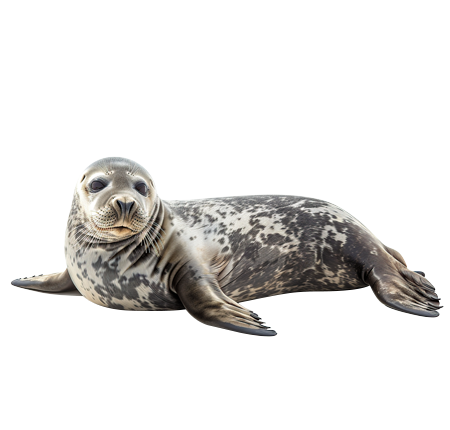
The harbor seal (Phoca vitulina), also known as the common seal, is a species widely distributed along the coasts of the Northern Hemisphere. Recognizable by its spotted coat and round face, these seals are expert swimmers and feed on fish, mollusks, and crustaceans. Their sociable and adaptable behavior makes them an interesting subject of study and observation in their natural habitat.
Harbor Seal
Species
P. vitulina
Order
Carnívora
Family
Phocidae
Conservation status
Bajo riesgo (Preocupación menor)

Characteristics
Behavior, Diet, and Habitat
Interesting Facts
Characteristics
Its head is round and lacks external ears, and it has whiskers called vibrissae that allow it to detect any movement in the water. Its mottled gray coat can range from lighter to darker depending on the concentration of melanocytes. Beneath the skin, they have a thick layer of blubber that provides both energy and insulation. They are physically adapted to maximize propulsion while diving. Their flippers are webbed, with five digits ending in strong claws. For speed and agility in the water, they use their hind flippers along with undulating movements of the body. Adult males usually measure 1.5–1.9 m in length and weigh 60–160 kg, while females measure 1.3–1.7 m and weigh 50–105 kg. However, size can vary depending on the geographic region: seals from Alaska and the western Pacific are larger than those from the Atlantic and eastern Pacific. Their breeding season varies from March to September, and after a 10–11 month gestation, a single pup is born weighing 8–12 kg. After the breeding season, they begin molting, a process in which they shed and renew their fur to restore its waterproof quality.
Harbor seals have a respiratory and cardiovascular system adapted to withstand prolonged dives. They can reduce their heart rate and divert blood flow to vital organs during submersion, allowing them to remain underwater for up to 30 minutes in extreme cases. They use vocalizations and physical behaviors to communicate with each other, especially during breeding and molting seasons. They have excellent underwater vision and good hearing both in water and on land, which helps them detect prey and predators. Their vibrissae are extremely sensitive and can detect even the slightest vibrations in the water, enabling them to hunt even in low-visibility conditions. In addition, their thick skin and blubber not only provide thermal insulation but also serve as an energy reserve during periods when food is scarce.
Behavior, Diet, and Habitat
At sea, harbor seals are usually seen alone, but they may sometimes form groups to feed when prey concentrations are high. Seals can display cooperative hunting behaviors, especially when feeding in areas with a high density of prey. In addition to coastal areas, some populations may migrate to deeper, colder waters at certain times of the year to follow prey availability. In some regions, harbor seals have learned to follow fishing boats to take advantage of discarded fish. They are generalist feeders, consuming a wide variety of fish, cephalopods, and crustaceans. Their diet is highly varied and influenced by seasonal changes in prey abundance. They mainly hunt along the coast at depths of less than 100 m, although dives as deep as 480 m have been recorded in Alaska.
Harbor seals live primarily in coastal waters and are commonly found in bays, estuaries, and intertidal zones. They typically stay close to the water to allow for a quick escape from threats. In their habitats, seals use burrows and caves for shelter, and they are often seen resting on rocks or sandy beaches. During migrations, they can travel hundreds of kilometers in search of food-rich areas. Their ability to adapt to different habitats and food sources makes them resilient, though they remain vulnerable to habitat loss and pollution. Seals also display thermoregulatory behavior, gathering in large numbers to conserve heat in cold climates or spreading out and resting in cooler waters to avoid overheating in warmer temperatures.
Interesting Facts
Harbor seal mothers’ milk contains nearly 50% fat, which allows pups to grow quickly and become independent within 4–6 weeks. This leads to earlier weaning, meaning mother and pup spend less time on land exposed to predators. The life expectancy of harbor seals is approximately 30–35 years but varies between males and females, with females living longer. Males live around 25–30 years, while females live around 30–35 years.
Young seals are very playful, often interacting with each other and with floating objects in the water. This not only keeps them physically active but also improves their hunting and social skills. Their main predators include sharks, orcas, and occasionally polar bears. Although their sense of smell is not as developed underwater, on land they can detect scents to communicate and recognize their pups. During the breeding season, mothers are extremely protective and use specific vocalizations to call and guide their young.
Harbor seals also have a remarkable ability to learn and remember migration routes and feeding grounds, which is crucial for survival in changing environments. Their social behavior during molting is particularly interesting: they gather in large numbers, which provides safety from predators and encourages social interaction. This collective behavior is also a strategy for sharing information about the best feeding and shelter areas.
In addition, harbor seals are able to adjust their diet and hunting behavior in response to prey availability, demonstrating notable adaptability. This trait helps them survive in diverse environments and cope with fluctuations in prey populations.


You can find them in...
Learn more...
What are the differences between seals and sea lions?
16 August, 2019
No Comments
Most people tend to confuse sea lions with their distant relatives: seals. Although they may seem similar at first sight, we are going to explain what the most significant differences