

Low risk (Least concern)
Harris's Hawk
Species
Parabuteo unicinctus
Order
Parabueto
Family
Accipitridae
Conservation status
The Harris’s hawk (Parabuteo unicinctus) is a member of the genus Parabuteo. It can be found in semi-open habitats in the southwestern United States and northwestern Mexico, extending south through Central and South America to Chile and as far as Patagonia.

Characteristics
Behavior, Diet, and Habitat
Interesting Facts
Characteristics
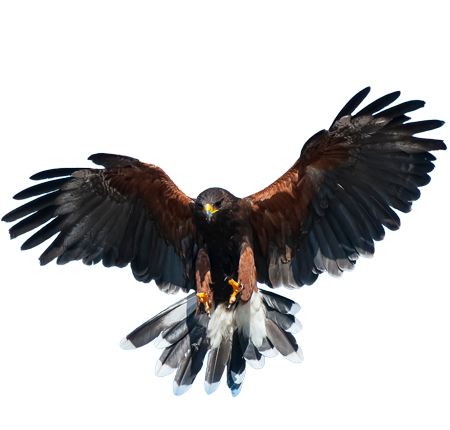
These are large hawks with long tails and broad wings. Harris’s hawks measure between 46 and 76 cm and have a wingspan of 100 to 120 cm. The plumage of adults is uniformly chocolate brown, with reddish shoulders, upper and lower wing coverts, and leg feathers. The tail is dark, with white upper and lower coverts and both a white base and a white terminal band. These hawks also have strong legs and sharp talons that allow them to capture and hold their prey effectively. Their sharp eyes provide excellent vision for spotting prey from great heights.
The beak of the Harris’s hawk is robust and hooked, ideal for tearing the flesh of its prey. The tail feathers, which display a distinctive white band at both the base and the tip, aid in maneuverability during flight. Juveniles have lighter plumage than adults, with more variations of brown and reddish tones, and their eyes are bluish gray, turning bright yellow as they mature.
The structure of their wings allows sustained and agile flight, suitable both for long distances and for quick, precise maneuvers during hunting. Their plumage, though predominantly brown, has a soft texture that minimizes noise during flight, helping them approach prey stealthily. In addition, their muscular legs and sharp talons not only enable them to capture but also to handle and transport large prey with great skill.
Behavior, Diet, and Habitat
Harris’s hawks are non-migratory and diurnal. They form complex social groups that assist in the nesting cycle. Most often, these groups are trios composed of two males and one female, though groups of four or five hawks are not uncommon. This unique social behavior allows them to achieve greater success in both hunting and defending their territories. Their diet is versatile and varies depending on prey availability. They feed primarily on small mammals such as rats and mice, but also on birds and lizards. They often hunt in groups of around five individuals, which increases their success rate.
Harris’s hawks can be found in a range of habitats, from desert highlands to forests. In urban areas, they are often seen using washes, open fields, and open desert zones. These hawks can be found at altitudes between 400 and 1,000 meters. They also adapt well to agricultural and suburban areas, where prey is abundant. Their nests are large stick structures, located in tall trees or on cliffs, where females lay between two and four eggs that are incubated for about 35 days. Both parents participate in feeding and caring for the chicks until they are able to fly and hunt on their own.
Teamwork during hunting allows Harris’s hawks to tackle larger and more difficult prey, such as rabbits and hares, which would be inaccessible to a bird hunting alone. This cooperative hunting method is rare among birds of prey and requires sophisticated communication and coordination among group members. Their ability to adapt to a wide variety of environments and their diverse diet make them highly resilient to ecosystem changes, contributing to their success as a species.
Interesting Facts
Within these groups, there is a strict dominance hierarchy. The breeding female, or alpha, is dominant over all other members of the group. Occasionally, there is a second female who is subordinate to the alpha female but dominant over all other males in the group. The breeding male, or alpha, is dominant over the other males. Typically, there is also a beta male who may attempt, often unsuccessfully, to mate with the alpha female. Harris’s hawks are capable of relying on much larger prey when hunting in groups. This aspect of cooperative hunting and food sharing increases the survival rates of the birds as individuals. Moreover, this social cooperation in hunting is rare among raptors, making Harris’s hawks an interesting case study for biologists.
Harris’s hawks are known for their intelligence and trainability, which makes them a popular choice in falconry. They are one of the few raptors that allow humans to integrate into their social hierarchy during training, displaying remarkable adaptability and trust. In captivity, these hawks can live up to 20 years, and their cooperative nature and social behavior help them adapt well to life with humans when provided with proper care.
Studies on Harris’s hawks have revealed that they possess advanced spatial memory and can remember the locations of their hunting grounds and nests for long periods. Their cooperative hunting behavior not only increases efficiency but also reduces individual risk by distributing the tasks of capturing and processing prey. This species also demonstrates a remarkable use of strategies and tactics during hunting, adapting its methods according to prey type and environment.
In terms of conservation, although they are not currently endangered, Harris’s hawks face threats such as habitat loss and declining prey availability. Conservation programs focus on protecting their natural habitats and educating the public about the importance of these hawks in the ecosystem. Collaboration between conservationists and falconers has been crucial in monitoring wild populations and ensuring the continuity of the species.