

Threatened (Vulnerable)
Humboldt Penguin
Species
Spheniscus humboldti
Order
Sphenisciformes
Family
Spheniscidae
Conservation status
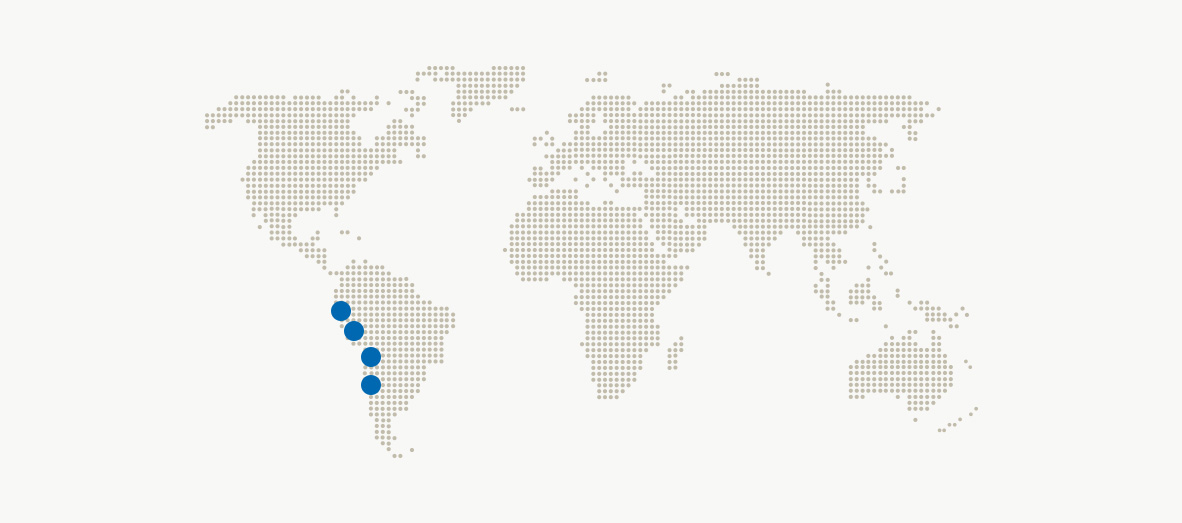
The Humboldt penguin (Spheniscus humboldti) is a flightless bird that inhabits the Pacific Ocean along the west coast of South America in Chile and Peru, an area influenced by the Humboldt (or Peruvian) Current, ranging from 5º to 41º 55′ south latitude.
Characteristics
Behavior, Diet, and Habitat
Interesting Facts
Characteristics
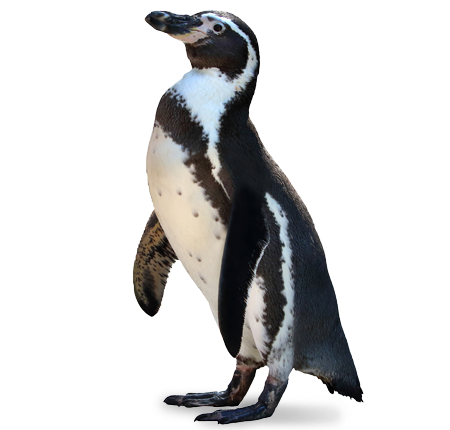
It is a compact-looking bird with black plumage on its back and white on its chest and belly. It also has a band of black feathers around the chest and some black spots on the stomach. The skin on its face is pink, and its beak has gray and black markings. It measures between 45 and 60 centimeters and weighs approximately four to five kilos. This bird, known as the Humboldt penguin, is endemic to the coasts of Peru and Chile and is adapted to aquatic life with stiff flippers and a streamlined body that allows it to swim with great efficiency.
The Humboldt penguin has dense, oily plumage that provides excellent waterproofing and thermal insulation, protecting it from the cold waters of the Pacific Ocean. Its wings, although not designed for flight, are perfect for swimming, acting as flippers that allow them to reach speeds of up to 20 km/h underwater.
Its eyes are adapted to see clearly underwater, which is crucial for hunting prey. In addition, these penguins have a supraorbital gland that helps them expel excess salt from the seawater they ingest, an essential adaptation for life in a marine environment.
The beak of the Humboldt penguin is robust and designed to catch and hold onto slippery prey. Their legs are short and set towards the back of the body, giving them an upright posture and allowing them to walk with a characteristic waddle. The feet are equipped with sharp claws that help them climb the rocks and cliffs where they nest.
Humboldt penguins also display a remarkable ability for thermoregulation, using their flippers and bare patches of skin to release excess heat, which is important when they are on land under strong sunlight. These birds have highly developed social behavior, living in large colonies where communication through vocalizations and visual displays is essential for group cohesion.
Behavior, Diet, and Habitat
They have very rarely been found as vagrant specimens in the Atlantic, reaching as far north as Mar del Plata in Argentina. In recent years, their populations have been drastically reduced due to the scarcity of nesting sites, decline in food availability, predation by humans, and above all, the impact of severe climatic events such as El Niño. They live in colonies on headlands and protected coastal islands, along with other guano bird species. To nest, they dig burrows in guano or salty soil, or use existing cracks among rocks and natural caves. One of the problems identified by researchers is that, when guano is extracted from the surface of the islands, penguins are unable to dig into the hard rock, significantly limiting their chances of reproduction.
Humboldt penguins lay two eggs of different sizes, which are incubated by both parents for approximately 35 days. Generally, only the first chick survives. The chicks are protected in the nest until they are 20 days old, after which they join the young of other penguins to form large crèches, while the parents go out to sea to feed. Both parents continue feeding their chicks for about two and a half months. Their diet consists mainly of small fish such as anchovies and sardines, as well as squid and crustaceans, which they catch by diving.
Interesting Facts
The Humboldt penguin is endangered. Despite being a subject of interest and study for researchers, it is continuously pursued for its gastronomic qualities. Chicks are also sought after to be used as domestic pets. At Mundomar, we contribute to the conservation of this species and to research for its continuity. These penguins are known for their fidelity to their mates, forming monogamous bonds that can last a lifetime. In addition, they have the ability to travel long distances in search of food, demonstrating remarkable endurance and navigational skills in the ocean.