

Kirk's Dik-Dik
Species
Madoqua
Order
Artiodactyla
Family
Bovidae
Conservation status
Low risk (Least concern)
A dik-dik is the name given to any of the four species of small antelopes of the genus Madoqua that live in the bushlands of eastern and southern Africa.
Dik-diks stand about 30–40 centimeters at the shoulder, measure 50–70 cm in length, weigh 3–6 kilograms, and can live up to 10 years. They are named after the alarm calls of the females. In addition to the females’ alarm call, both males and females produce a shrill, whistling sound. These calls can alert other animals to the presence of predators.
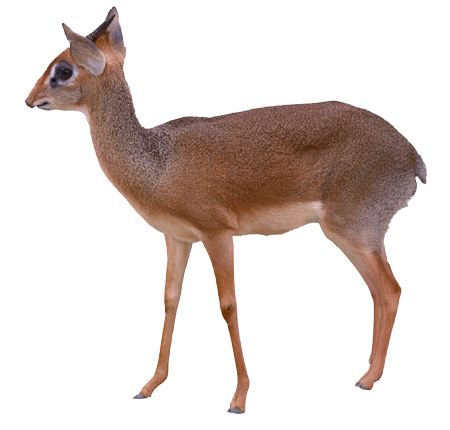

It is considered the second smallest antelope in Africa. It measures 55–72 cm in length from head to tail, 30–40 cm in height, and weighs between 3–7 kg.
The coloration of its body ranges from yellowish gray to brown, with the underside being lighter. A very distinctive feature is its prehensile snout, which it can move in all directions. In addition, they have a gland near each eye that they use to mark territory, and a tuft of hair on the forehead that they raise when agitated.
They exhibit sexual dimorphism, making it easy to distinguish males from females, as males are the only ones with horns (4–11 cm). They reach sexual maturity early, before their first year of age. Gestation lasts 5 to 6 months, so they can reproduce up to twice a year, usually giving birth to a single offspring at a time.
It inhabits shrubland areas of the savanna, specifically in East Africa (Somalia, Kenya, and Tanzania) and in the South (Namibia and Angola). They live territorially in monogamous pairs along with their offspring, although the young must leave the group at an early age.
They are shy and elusive animals, hiding among the bushes. When they feel threatened, they run quickly, leaping and moving in a zigzag pattern. They also produce alarm calls that sound like “zik-zik” or “dik-dik.”
They are herbivores, feeding on easily digestible plant matter with low fiber content. About 80% of their diet consists of leaves from trees and shrubs, 17% from grasses, and the rest from herbs and reeds. They mainly feed in the early morning and at dusk.
When it comes to the birth of their young, they are born headfirst with their front legs folded backward—an unusual fact, since most ruminants are born with their front legs extended. They are territorial animals that can inhabit the same area for years. To do so, they mark their territory with urine and feces through a ritual that also serves to strengthen the pair bond. In this process, known as the “defecation ceremony,” the female defecates and urinates first, followed by the male who does the same. They conclude the ceremony by marking nearby plants with secretions from their preorbital gland.