

Mediterranean Tortoise
Species
Testudo hermanni
Order
Testudines
Family
Testudinidae
Conservation status
Near Threatened (NT)
This terrestrial tortoise is characteristic of the warm environments of southern Europe, including regions of Spain, France, Italy, and the Balkans. It is easily recognized by its rounded shell and its distinctive yellow and black coloration, with well-defined patterns that vary between individuals.
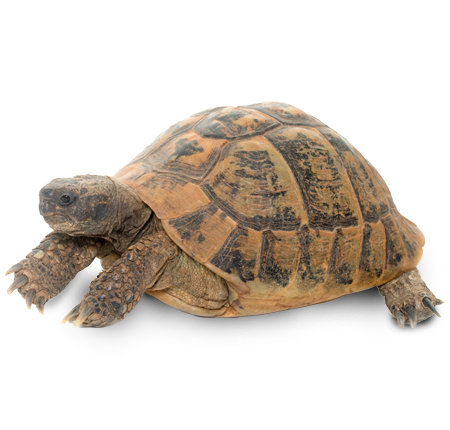

The Mediterranean tortoise (Testudo hermanni) is one of the five tortoise species traditionally classified within the genus Testudo. These are herbivorous, diurnal reptiles that can often reach lifespans comparable to humans.
Its size varies between subspecies: T. h. hermanni grows up to 18 cm, while T. h. boettgeri can reach 28 cm. Its coloration consists of a shell with yellow and black tones in defined patterns.
The difference between males and females is that males usually have longer and wider tails, as well as a concavity in the plastron.
In terms of longevity, they can live more than 50 years, and even exceed 100 years under optimal conditions.
Tortoises have excellent vision: they can distinguish shapes and colors, and can even recognize people. They also have a very precise sense of orientation; if moved a few hundred meters from their territory, they usually return in a short time. They are very sensitive to ground vibrations even though their hearing is not well developed. On the other hand, their sense of smell is well developed and plays an important role in the search for food and mates.
It is a Palearctic species that inhabits only southern Europe. The range of the Mediterranean tortoise extends from Spain to Romania, including the large islands of the Mediterranean Sea (Sardinia, Corsica, Sicily). It inhabits different areas of Spain, France, Italy, Bosnia and Herzegovina, Croatia, Serbia, Montenegro, Albania, North Macedonia, Bulgaria, Romania, and Greece.
Its habitat is typically Mediterranean, characterized by mild winters with moderate rainfall and dry summers with high temperatures.
Mediterranean tortoises are ectothermic animals that bask in the sun during the early hours of the day in order to warm their bodies and accelerate metabolic functions. Sun exposure allows them to absorb ultraviolet rays necessary for vitamin D synthesis. At atmospheric temperatures above 27 °C, tortoises become lethargic and dig small burrows covered by low vegetation or hide in crevices to cool down. When temperatures drop again, they return to activity.
In autumn, with decreasing temperatures, these reptiles stop feeding for up to twenty days to completely empty their intestines of food remains. They gradually become more lethargic, and by November or December, depending on latitude, they begin to bury themselves or take refuge in sheltered places, entering a state of hibernation. Hibernation is a vital metabolic phase for this species, and the only factors that may prevent it are disease or other debilitating conditions.
They reach sexual maturity at about nine years of age. Species of Testudo are oviparous: they lay their eggs in burrows dug in the ground by the female with her hind legs. Female T. hermanni lay eggs two or three times per year, between May and June. The number of eggs depends on the size of the individual.
The incubation period lasts two to three months, and the sex of the hatchlings depends on ambient temperature. If the incubation temperature is below 31.5 °C, males predominate, whereas if the temperature is higher, there will be more females.
In terms of feeding, wild specimens live in habitats characterized by long periods of drought, which force them to feed on dry grasses. In these cases, they supplement their diet by eating arthropods or snails; the latter provide an important source of calcium, essential for shell growth. Occasionally, they may also eat feces or small pieces of carrion.
Their diet is mainly vegetarian, although it is occasionally complemented with some invertebrates. The basis of their diet consists of wild plants: alfalfa, thistles, dandelion, plantain, clover, yarrow, honeysuckle, rosemary, sage, lemon balm, chicory, watercress, and lamb’s lettuce are all suitable plants to feed tortoises thanks to their high calcium-to-phosphorus ratio and fiber content.
The epithet “hermanni” honors the French naturalist Johann Hermann, who was also a physician.
Specimens raised under human care are often overfed. They should never be given meat, milk, cheese, dog or cat food, eggs, bread, citrus fruits, or kiwis. They also need to drink water and must always have clean water available for both drinking and bathing. They are strictly vegetarian reptiles.
The destruction of their habitat and their popularity as pets have significantly reduced wild populations, making protection efforts indispensable to ensure the long-term survival of the species.
Mediterranean tortoises are at risk of disappearing in the wild, mainly due to anthropogenic factors such as mechanized agriculture and pesticide use, road traffic, wildfires, environmental destruction, urbanization, illegal capture, and the threat of new predators.