

Endangered (At risk)
Morish Tortoise
Species
T.graeca
Order
Testudines
Family
Testudinidae
Conservation status
This terrestrial tortoise is distributed across southern and eastern Europe, as well as northern Africa. In the Iberian Peninsula, it is found only in the Guadalquivir marshes and the semi-arid southeast. The three Spanish regions it inhabits are: Mallorca, Doñana National Park, and Murcia/Almería.
Classified as endangered, its main threats are habitat degradation and fragmentation, as well as illegal collection for the pet trade.
It is important to know that:
For years, the sale of these animals has been considered a crime.
Since 2015, the possession of a spur-thighed tortoise has also been a crime.

Characteristics
Behavior, Diet, and Habitat
Interesting Facts
Characteristics
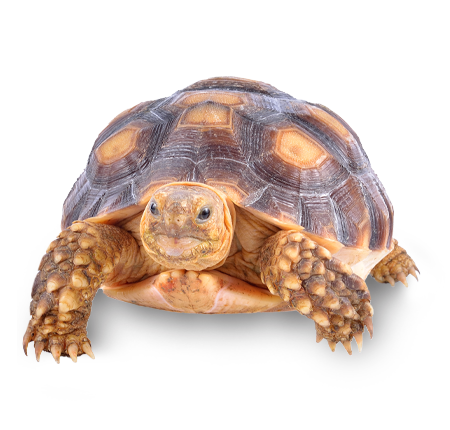
Its shell is domed, with a coloration that ranges from yellow to olive green. The scutes that make up the shell have black edges, and the central area features black markings. Its plastron (the underside of the shell) is yellow with black spots, which are much more noticeable in young individuals.
Males and females can be distinguished by their physical characteristics (sexual dimorphism). Males are smaller (up to 15 cm) and have a long, robust tail, whereas females reach up to 18 cm and have a short tail. In addition, the female’s plastron is flat, while the male’s is concave to facilitate mating.
After hibernation, the breeding season begins, during which males pursue females to mate. A few days before laying eggs, the female displays dominant behavior and chooses a spot to bury the eggs. After 2–3 months of underground incubation, the hatchlings emerge. The sex of the young is determined by the temperature during incubation.
Behavior, Diet, and Habitat
It lives in dry, very sunny environments with open vegetation (shrubs and scrubland), which is why it is considered a thermophilic species with a preference for semi-arid habitats.
They can inhabit areas ranging from sea level up to 800 meters in altitude, with temperatures between 1.5°C and 33.2°C, and annual rainfall between 233 mm and 640 mm. However, areas with low rainfall may limit their food resources, while areas with high rainfall may interfere with their thermoregulatory needs.
Their diet is primarily herbivorous, although they also supplement it with insects and carrion.
Interesting Facts
According to paleontological and genetic evidence gathered so far, the Spanish populations of the spur-thighed tortoise were most likely introduced from North Africa. Some supporting evidence includes the fact that no fossils from that era have been found at any Spanish site, and genetic studies reveal that the populations in northern Morocco are identical to those in the Iberian Peninsula.