

Threatened (Vulnerable)
Otters
Species
Aonyx cinerea
Order
Carnívora
Family
Mustelidae
Conservation status
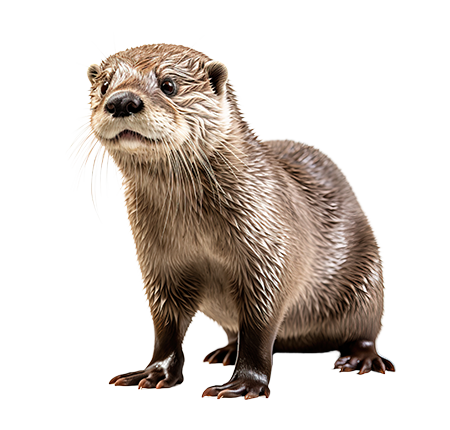
Otters are a subfamily of carnivorous mammals belonging to the large Mustelidae family. There are 13 species of otters spread across 7 genera, one of them with an almost worldwide population distribution. At Mundomar, we have a colony of Asian small-clawed otters (Aonyx cinerea), native to Southeast Asia.

Characteristics
Behavior, Diet, and Habitat
Interesting Facts
Characteristics
ChatGPT Plus
Otters are animals that feel more at home in the water than on land. They have a dense, waterproof coat that helps them retain body heat. They are excellent swimmers and can close their nostrils underwater, allowing them to stay submerged for up to 6 minutes without surfacing to breathe. When swimming at high speed, they move their legs and tail gracefully up and down. They only use their forelimbs when swimming slowly. In the water, they can reach speeds of up to 12 km/h. In addition, their elongated and flexible body, combined with their webbed feet, gives them remarkable agility and maneuverability underwater, enabling them to catch prey and evade predators efficiently. Otters also have sensitive whiskers that help them detect the movement of prey in murky waters, and their semi-retractable claws allow them to skillfully handle food and tools.
The otter’s body is hydrodynamic, reducing water resistance during fast swimming. They also have a layer of subcutaneous fat that helps maintain body temperature in cold waters. Their eyes and ears are small and adapted to minimize water entry while swimming. Furthermore, their tail—thick at the base and tapering toward the tip—provides excellent directional control and assists with propulsion.
Otter fur is made up of two layers: an inner layer of soft, dense hair that provides thermal insulation, and an outer layer of longer, coarser hairs that act as a waterproof barrier. This not only keeps them warm in cold waters but also allows them to dry quickly when on land.
Behavior, Diet, and Habitat
They feed exclusively on fish, which they hunt in groups of two to five individuals. They live in family groups, usually consisting of breeding pairs, pups, and subadults. The latter help care for the young but do not reproduce until they leave the family group. The Spanish conquistadors nicknamed them “river wolves.” Otters are also credited with tool use: they pick up a stone from the seabed, place it on their chest while floating on their back, and strike mussels against it until they crack open—making them, alongside primates, the only mammals known to use some type of “tool.” They are an endangered species, and in many regions hunting them is prohibited. Their natural predator is the orca. Otters inhabit rivers, lakes, and coastal areas, preferring water bodies with abundant riparian vegetation that offers both shelter and access to prey. They also build dens near the water, with submerged entrances for added protection. In addition, otters create “play” areas in mud or snow, which they use both for leisure and to maintain their motor and social skills.
Otters’ tool use is not limited to stones. They may also use shells and other hard objects to break open the shells of their prey. This behavior demonstrates a high level of intelligence and adaptability. Otters also display a complex social system, in which non-breeding juveniles help care for the pups, increasing survival rates.
Otters are territorial and mark their areas with scent glands located near their tail. They use these markings to communicate with other members of their species and to avoid conflicts. Territories often cover several kilometers of rivers or coasts, and otters patrol them regularly to maintain dominance.
Otters are mainly crepuscular, meaning they are most active at dawn and dusk. However, they can adapt to being more diurnal or nocturnal depending on food availability and the presence of predators. Their diet is not limited to fish; they also eat amphibians, crustaceans, and occasionally small mammals and waterfowl.
Interesting Facts
Otters can go into heat at any time of year; however, their reproduction is slow and irregular, although more births are observed during spring. Each litter usually results in two or three pups, born blind and toothless. Their nursing period lasts about two months, and they leave their mother’s territory after approximately one year, when they begin to roam in search of their own territory—usually establishing one about two years after birth. Otters are also known for their varied vocalizations, including whistles, growls, and squeals, which they use to communicate with group members. They are very playful as well, often seen sliding down natural mud or snow slides, which provides exercise and strengthens social bonds. Otters can also use their building skills to create simple structures like dams and tunnels, helping them manage their environment and increase protection against predators. Additionally, their diet may vary slightly depending on seasonal prey availability, allowing them to adapt to ecosystem changes.
Social interaction is crucial for otters, and they spend a lot of time grooming each other, which not only reinforces social bonds but also keeps their fur in good condition. During play and grooming, otters learn important skills for hunting and survival.
Otter pups begin swimming at around eight weeks of age, under the supervision of their mother. She teaches them to swim, dive, and search for food. Young otters are curious and exploratory, often seen investigating their surroundings and playing with objects found in the water and along the shore.
Otters also have remarkable memory skills and can remember the location of feeding sites and shelters for long periods. This behavior allows them to move efficiently within their territory and maximize their success in finding food. Regarding conservation, otters face multiple threats, including water pollution, habitat loss, and poaching. Conservation efforts include protecting their natural habitats, creating reserves, and implementing captive breeding programs to ensure the survival of the species.
