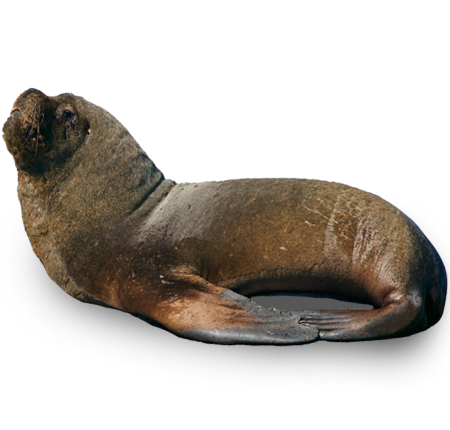
Patagonian sea lions (Otaria flavescens) are black in their youth and turn dark brown as they reach adulthood. Adult males usually weigh around 300 kg, twice as much as females, and have a reddish-brown mane of hair around the neck. This “mane” is the reason they are called “sea lions.” They live in colonies of about 15 individuals formed by the male, his harem, and a few young specimens. Their lifespan ranges between 25 and 50 years. Their diet consists of fish, octopus, squid, penguins, and other seabirds, consuming between 15 and 25 kg of food per day. They are preyed upon by orcas.
They have a streamlined body with a layer of fat beneath the skin that provides warmth and buoyancy. Their large eyes help them adapt to low light levels in the underwater environment, while their whiskers enhance their sense of touch. Their nostrils close automatically when they touch the water, preventing water from entering and allowing them to dive efficiently. Their long foreflippers rotate outward for better movement on land and propel them forward in the water, where they spend most of their time. These physical adaptations allow them to be agile and efficient both on land and in the water.
Patagonian sea lions have dense fur that provides thermal insulation and protection against the cold. During their annual molt, they shed and renew their fur to maintain water resistance and insulating capacity. Males develop their characteristic mane upon reaching sexual maturity, giving them an imposing appearance and helping them intimidate rivals during competition for females. Juveniles have softer, shorter fur that becomes thicker and more resilient as they age.
They inhabit the South American coasts, both in the Atlantic and the Pacific. They are found along the coasts of the Galápagos Islands (Ecuador), Peru, Chile, Argentina (including the Falkland Islands), Uruguay, and Brazil (south of Recife dos Tôrres). Occasionally, wandering populations have been observed in Colombia and Panama. They were once also found on Lobos Island (Fuerteventura), before fishermen eradicated the species, believing that their voracity reduced local marine resources.
They are highly social and are commonly seen in large groups on cliffs, coastlines, and even on docks and navigation buoys. Males are territorial and maintain harems of around fifteen females each. Mating usually occurs between May and June, and females give birth to a single pup—on land or in the water—after a 12-month gestation period. They are the only mammals whose milk does not contain lactose. During the breeding season, males aggressively defend their territories and harems, using vocalizations and physical displays to keep rival males away.
In terms of diet, Patagonian sea lions are opportunistic, and their feeding habits vary depending on prey availability. In addition to fish and squid, they occasionally consume crustaceans and other marine invertebrates. Their ability to dive to great depths allows them to exploit food resources unavailable to other species. They can dive as deep as 200 meters and remain underwater for several minutes, efficiently using their oxygen reserves.
Humans once hunted them for meat and oil, but the main reason they were pursued was for the skins of newborn pups, called “popos” (from the English puppy). They are well known for their intelligence and learning ability, which allows them to perform tricks and follow commands in captivity. They are often seen around ports and marinas, where they have learned to interact with humans and seek out food.
There are different subspecies of sea lions in various regions, adapted to specific local conditions. In the wild, sea lions can live between 15 and 20 years, while in captivity they may reach up to 30 years due to the absence of predators and the constant availability of food. Their main predators are orcas and great white sharks. Pups may also be vulnerable to birds of prey and other marine mammals.
Patagonian sea lions also have a complex social structure, with well-defined hierarchies within colonies. Dominant males establish and defend their breeding territories through aggressive behaviors and displays of strength. Females, on the other hand, form smaller groups and often cooperate in raising their young, which increases pup survival rates.
During molting season, sea lions gather in specific areas where they can safely shed and renew their fur. This process is vital to maintaining the quality of their coat, which provides thermal protection and buoyancy. In addition, sea lions display curious and playful behavior, especially juveniles, who frequently engage in games and activities that strengthen their hunting skills and social cohesion.

 Published in