

Rainbow Lorikeet
Species
Trichoglossus haematodus
Order
Psittaciformes
Family
Psittaculidae
Conservation status
Least Concern (LC)
The rainbow lorikeet (Trichoglossus haematodus), also known as the coconut lorikeet, is one of the most colorful and sociable birds in the world. Native to Oceania and Southeast Asia, it stands out for its vibrant plumage and its active, playful behavior.
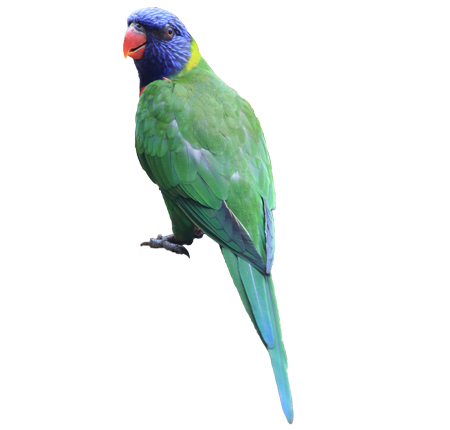

The morphology of the rainbow lorikeet truly lives up to its name — its body is a symphony of colors, with green being the dominant shade. It has multicolored plumage: a blue head, yellow collar, red chest with blue bands, and green upperparts. Its body is robust, and the tail is pointed. The beak in juveniles is dark brown, while in adults it turns orange or red.
They can be distinguished by iris color: in males it is deep red, while in females it is orange.
It has a brush-tipped tongue, perfectly adapted to absorb nectar and pollen.
During flight, it spreads its wings, showing bright, striking tones, while emitting shrill calls; in contrast, when feeding, it is silent and discreet.
The species is widely distributed across New Guinea, Indonesia, Timor, Vanuatu, the Solomon Islands, and the eastern coast of Australia, including Tasmania. It is common in tropical forests, mangroves, wooded urban areas, and plantations. Its adaptability has allowed it to establish introduced populations in places like New Zealand and Hong Kong.
Several subspecies are recognized, such as T. h. haematodus, T. h. massena, and T. h. flavicans, which are differentiated by variations in plumage and geographic distribution.
In terms of diet, it is primarily nectarivorous and frugivorous, feeding on nectar, pollen, fruits, flowers, and occasionally insects and seeds. In other words, it consumes soft foods rich in proteins and vitamins. Its adaptation to this type of diet is evident in the shape of its tongue, which resembles a brush designed to lap up nectar from flowers. It also uses its beak to crush fruit pulp and extract juice and seeds.
For habitat, rainbow lorikeets prefer rainforests, coastal scrublands, open woodlands, and urban areas with abundant vegetation. They are highly social birds, living in pairs or flocks of up to 20 individuals.
When it comes to breeding, males and females work together to prepare the nest, either in hollows of rotten wood or in the outer branches of eucalyptus trees. Their reproduction involves nesting in tree cavities, where they usually lay two white eggs, which are incubated for 23 to 26 days.
In captivity, they are like any other bird: they need love and attention to build trust, and they gradually become very affectionate and attached to people.
Because they are such loving and playful birds, they require a significant amount of time and dedication, which makes them unsuitable for people with little free time. For this reason, it is also recommended that they be kept in large cages or spacious areas, with toys to play with—especially those that make noise or allow them to climb or peck.
However, they are not as friendly with other types of parrots, since they have a territorial nature and can become aggressive towards them.
Another interesting fact is that they are fond of bathing, so it is ideal to provide them with a container that can serve as their bath.
