

Red-eared slider
Species
Trachemys scripta elegans
Order
Testudines
Family
Emydidae
Endangered
Low risk (Least concern)
Although it is a species native to the eastern and central United States, it is currently present in many countries around the world. This includes Spain, where it was introduced, and for years it has been considered an invasive species, as it poses a threat to our native freshwater turtles. Globally, it is included in the list of the 100 most invasive species on the planet.
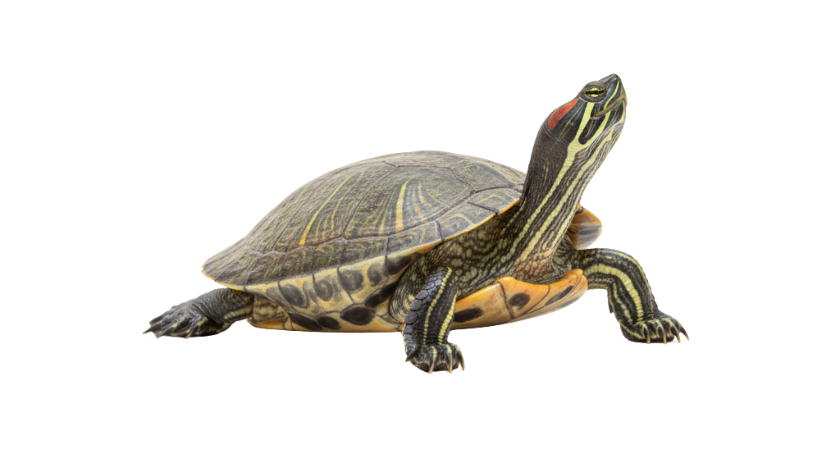

Medium-sized freshwater turtle characterised by the presence of a striking red spot on each side of its head. Its head, neck and limbs have yellow lines, also very characteristic of this turtle. The carapace is green in colour, which darkens with age (hatchlings are a more striking green).
They are sexually dimorphic, with the male being smaller than the female. Males can measure up to 24 cm and weigh 1.4 kg, while females can measure 30 cm and weigh 2.7 kg. In addition, males have longer tails and long nails on the front legs, which are used for mating.
Breeding season is between April and August. Females dig a hole with their hind legs and lay 9-11 eggs per clutch. The eggshell is flexible, and requires certain humidity conditions to complete development. Incubation lasts about 62-73 days, and the sexing of the hatchlings is determined by the incubation temperature. At higher temperatures, female gonads develop, while at lower temperatures male gonads are produced. At 29°C, a similar number of males develop as females.
Its period of activity is between February and November, after which it hibernates discontinuously. It is a diurnal species that concentrates its maximum activity in the central hours of the day. They spend most of their time in the water, but regularly come out of the water to thermoregulate.
It is an omnivorous species, feeding on both animal and plant matter (leaves, seeds, algae, insects, tadpoles, fish, carrion…). Juveniles are more carnivorous than adults, eating around 70% of animal matter compared to 10% of adults.
In general, it can inhabit various aquatic environments. In Spain it is found in rivers, lagoons, reservoirs, ponds and coastal marshes (with low salinity).
Courtship takes place in the water. To do this, the male swims around the female until he stands in front of her. At that moment, he starts to move his front legs in front of the female’s face, as if trying to caress her with his long nails. If she accepts his proposal, the female will swim towards the male, and they will mate.