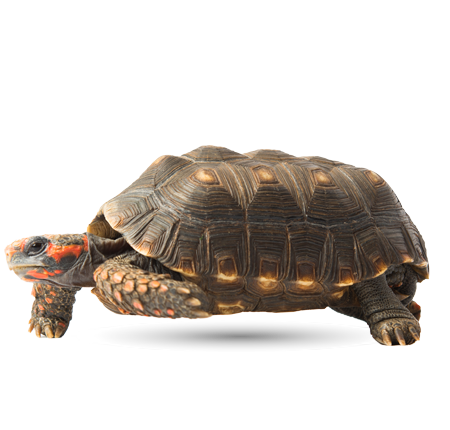
The red-footed tortoise measures between 25 and 40 cm and can reach a weight of up to 9 kg. Its shell varies in color from brown to black, with pale areas in the center of the scutes. The scales on its head, limbs, and tail are orange or reddish. Males are larger, with longer and broader tails than females.
They reach sexual maturity at around 5 years of age and can mate throughout the year. Females may nest several times annually, laying between 2 and 15 eggs in nests dug about 20 cm deep. The incubation period ranges from 117 to 158 days. Once hatched, the young are completely independent.
Diurnal in habit, they are most active in the morning and late afternoon, thus avoiding the midday hours and direct sunlight. They are considered a rather solitary species.
They are primarily herbivorous but also consume small amounts of animal matter, such as small invertebrates and carrion. Their diet includes grasses, leaves, flowers, bark, stems, and fruits.
This South American species can live in a variety of habitats, from savannas to humid forests, although it shows a preference for wooded areas.
The sex of the hatchlings is determined by the ambient temperature during their development inside the egg.
The male of this species produces sounds similar to those of chickens, called “clucking,” to attract females and drive away other males. He may make these sounds during courtship or mating. In addition, males compete with each other by performing head-bobbing movements until one of them eventually manages to flip the other over.