

Threatened (Critically Endangered)
Ring-tailed Lemur
Species
L. catta
Order
Primates
Family
Lemuridae
Conservation status
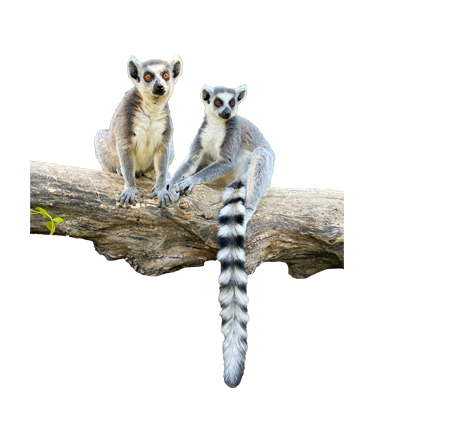
The ring-tailed lemur (Lemur catta) is the only species within the monotypic genus Lemur and, like other lemurs, is found exclusively in Madagascar. Locally known as hira or maky, it inhabits gallery forests and spiny scrublands in the southern regions of the island.

Characteristics
Behavior, Diet, and Habitat
Interesting Facts
Characteristics
It is an omnivorous animal and the most terrestrial of all lemurs; diurnal in behavior, it is active exclusively during daylight hours. It spends about 33% of its time on the ground, making it the most ground-dwelling of all lemur species. It is highly social, living in groups of up to thirty individuals, where female social dominance is evident—a common trait among lemurs. To conserve warmth and strengthen social bonds, groups huddle together, forming a “lemur ball.” They also enjoy sunbathing, sitting upright with their ventral side—whiter and thinner-skinned—facing the sun.
The size of the groups, their range, and population density vary depending on the region and food availability. Groups generally consist of six to twenty-five individuals, although some have been recorded with over thirty, with the average ranging from thirteen to fifteen. Ring-tailed lemurs are easily recognized by their gray and white fur and their black-and-white ringed tails, which they use for communication and balance. In the wild, they can live up to 16–19 years, while in captivity they may reach 25 years.
In addition, ring-tailed lemurs have a robust body structure adapted for life both on the ground and in the trees. Their hands and feet are highly prehensile, enabling them to climb easily and manipulate objects. Their ringed tail, besides being a visual hallmark, plays a crucial role in maintaining balance as they move through arboreal and terrestrial environments. This species shows notable sexual dimorphism in behavior rather than size, with females socially dominating males in all situations, including access to food resources.
Behavior, Diet, and Habitat
Their territorial range or home area varies between 6 and 35 hectares. Groups may maintain a territory, but overlap between them is common. When encounters occur in the wild, they are generally hostile. A group usually occupies the same area of its territory for three or four days before moving on. As with most lemur species, females socially dominate males in all situations, including feeding priority. This dominance is enforced through charging, chasing, slapping, grabbing, and biting.
Young females do not always inherit their mother’s rank, and young males leave the group between three and five years of age. As with other lemurs, the sense of smell is particularly important to them, and they mark territory with their scent glands. Males have a unique scent-marking behavior called “spur marking” and engage in so-called “stink fights,” in which they rub their tails with the scent glands on their wrists and then wave them toward rival males.
Their diet includes fruits, leaves, flowers, bark, and occasionally insects and small vertebrates. The availability of these foods varies seasonally, which influences their feeding patterns. They are found mainly in dry deciduous forests and gallery forests of southern and southwestern Madagascar. They can also inhabit rocky areas and spiny forests. During the dry season, ring-tailed lemurs rely heavily on the leaves and bark of drought-resistant trees, showing remarkable dietary adaptability.
Ring-tailed lemurs also exhibit a group resting behavior known as “roosting,” where large numbers gather in selected trees to spend the night. This behavior not only provides safety in numbers but also aids in thermoregulation, as the lemurs can retain body heat by huddling together.
Interesting Facts
It is one of the most vocal primates, using numerous vocalizations such as group cohesion calls and alarm calls. In addition to vocal sounds, they use body postures, facial expressions, and olfactory signals to communicate. Experimental studies have shown that these lemurs, despite not having a large brain (compared to simiiform primates), can organize sequences, understand basic arithmetic operations, and preferentially select tools based on their functional properties.
Ring-tailed lemurs display complex behaviors such as mutual grooming, which strengthens social bonds within the group. They are also essential seed dispersers in their ecosystem, contributing to the regeneration of Madagascar’s forests. Furthermore, they engage in a series of social rituals, such as “spur marking” and “stink fights,” which not only help establish hierarchies within the group but also serve as a form of competition without severe physical contact.
Ring-tailed lemurs are well known for their “sunbathing,” where they sit upright with arms outstretched to maximize sun exposure. This behavior not only helps regulate their body temperature but may also serve as a way of obtaining vitamin D through sun exposure. In captivity, ring-tailed lemurs have demonstrated the ability to learn how to use simple tools to obtain food, highlighting their cognitive capacity and adaptability.
Moreover, the conservation of ring-tailed lemurs is crucial, as their population has declined significantly due to deforestation and hunting. Conservation programs focus on protecting their natural habitat and educating local communities about the importance of these primates to the ecosystem. Research on the behavior and ecology of ring-tailed lemurs also provides valuable insights for their conservation and management in both natural and controlled environments.
