

Endangered (Critically Endangered)
Ruffed Lemur
Species
Varecia variegata
Order
Primates
Family
Lemuridae
Conservation status
Mundomar is proud to contribute to the conservation and breeding of one of the most endangered lemuriform mammal species on the planet: the Red Ruffed Lemur (Varecia variegata).

Characteristics
Behavior, Diet, and Habitat
Interesting Facts
Characteristics
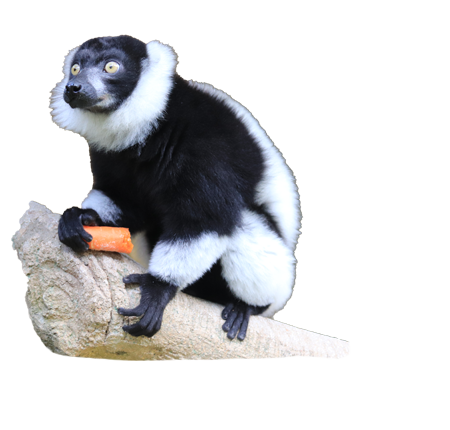
The black-and-white ruffed lemur, also known as the collared lemur (Varecia variegata), is a species of strepsirrhine primate in the Lemuridae family. Like all lemurs, it is endemic to Madagascar. It has dense, soft fur with striking black and white coloration, and a distinctive white ruff of fur around its neck. There is no marked sexual dimorphism in size, though females are typically dominant within the group. Black-and-white ruffed lemurs can weigh between 3 and 4.5 kg and measure around 100 to 120 cm in length, including their long tail.
These lemurs have a black face with an expressive gaze and large yellow eyes that provide excellent vision. Their prominent ears are covered in white fur, adding to their distinctive appearance. Their hands and feet are adapted for climbing, with opposable thumbs and adhesive pads that allow them to grip branches easily. The black-and-white ruffed lemur has a matriarchal social structure, with females leading the group. They also have a highly developed vocal repertoire, using a variety of calls for communication—from alarm cries to vocalizations that help maintain group cohesion. They are diurnal animals, meaning they are active mainly during the day.
In addition, these lemurs have remarkable leaping abilities, moving nimbly through the treetops. Their diet and feeding habits play a vital role in seed dispersal, making them crucial to the ecology of Madagascar’s forests. Their thick fur provides protection against insect bites and minor injuries. While their tail is not prehensile, it is used for balance and for visual communication with other group members. Black-and-white ruffed lemurs also possess advanced spatial memory, enabling them to remember the location of food resources and the boundaries of their territory.
Behavior, Diet, and Habitat
The diet of the black-and-white ruffed lemur consists mainly of sweet fruit, leaves, nectar, flowers, and seeds. They typically forage alone, later reuniting with their group to sleep. The most common predators of the black-and-white ruffed lemur are the boa constrictor, eagles, and the fossa (a nocturnal predator from Madagascar related to the mongoose). Since the black-and-white ruffed lemur is diurnal, the nocturnal fossa is its greatest threat.
They inhabit primarily the rainforests of eastern Madagascar, favoring areas of dense vegetation where food and shelter are abundant. They live in groups of 5 to 15 individuals, although larger aggregations may form during feeding season when resources are plentiful. Ruffed lemurs are territorial and mark their range using scent glands located on their rump and throat. These lemurs also build nests in trees, made from branches and leaves, where females give birth and care for their young.
During the dry season, their diet adapts, and they may consume more leaves and flowers when fruit is scarce. Territorial marking not only prevents conflicts between groups but also helps individuals navigate and locate resources within their home range. Ruffed lemurs display complex social behavior, spending much of their time interacting with other group members through grooming and play.
Interesting Facts
Currently, the species is classified as endangered due to the severe deforestation affecting the island of Madagascar. They have a specific breeding season, usually between May and July. Females give birth to 1–3 young after a gestation period of about 102 days. The infants are initially cared for in nests built by the mothers. They use a wide variety of vocalizations to communicate, including loud calls that can be heard over long distances, as well as purrs and grunts for close-range communication.
They are important seed dispersers, helping to maintain the biodiversity of Madagascar’s forests. Habitat destruction not only threatens their survival but also the health of the ecosystems they inhabit. Ruffed lemurs are known for their ability to perform impressive leaps between branches, allowing them to move quickly through the forest canopy. In addition, they show strong site fidelity, rarely leaving their home range unless forced to by a lack of resources.
The social life of ruffed lemurs includes a strict matriarchal hierarchy, where dominant females have priority access to food and resting sites. This matriarchal system also influences the reproductive structure of the group, with dominant females controlling male access to mating opportunities. In captivity, these lemurs have proven capable of adapting well, provided they are given an enriched environment that simulates their natural habitat and allows them to express their natural behaviors.
Conservation efforts for ruffed lemurs include the creation of protected reserves and the implementation of captive breeding programs. Additionally, efforts are being made to educate local communities about the importance of these animals and to promote sustainable practices that benefit both humans and lemurs. Continued research on the behavior, ecology, and genetics of ruffed lemurs is crucial to developing effective conservation strategies and ensuring the survival of this iconic species of Madagascar.
