

Sacred Ibis
Species
Threskiornis aethiopicus
Order
Pelecaniformes
Family
Threskiornithidae
Conservation status
Low risk (Least Concern)
This bird is characterized by its white and black plumage and by the absence of feathers on the neck and head. Its bill is long, black, and downward-curved. In addition, its eyes are brown with a pinkish lower eyelid. Its size ranges between 65 and 90 centimeters, and it can weigh up to 1.5 kg.
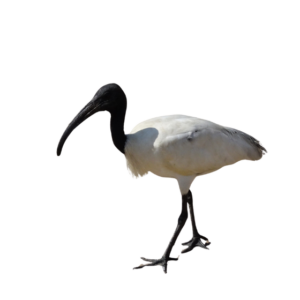

The sacred ibis is a fascinating bird species, especially due to its peculiar appearance and social behavior. It is distinguished not only by its black and white plumage, but also by its lack of feathers on the neck and head, which gives it a very unique look. Its long, black, slightly downward-curved bill is one of its main features, perfectly adapted for feeding on insects and small aquatic animals.
The eyes of the sacred ibis are a deep brown, with a pinkish lower eyelid, creating a striking contrast on its face. The size of this species varies, ranging from 65 to 90 centimeters in length and weighing up to 1.5 kg. Although there are no color differences between males and females, males are usually slightly larger and have longer bills than females.
During the breeding season, the sacred ibis undergoes a fascinating plumage transformation. The shoulder area develops a metallic blue sheen, and a reddish ring forms around the iris, further highlighting its beauty. This special coloration is a sign of the species’ sexual maturity.
In terms of social behavior, sacred ibises are gregarious birds that prefer to live in groups. Typically, their flocks range from 2 to 20 individuals, but formations of hundreds of birds have been recorded, especially in areas with abundant food. Living in groups allows them to share resources and protect each other from potential threats.
The sacred ibis follows breeding patterns that can vary depending on its geographic location, but generally begins its breeding season after the rainy period. During this time, large colonies can be observed, ranging from 50 to 2,000 pairs. In these colonies, the male collects nesting materials, while the female builds the nest. Nests can be found in trees, shrubs, or even on the ground, adapting to the environment to provide greater safety.
The diet of the sacred ibis is diverse and mainly depends on its habitat. It feeds on insects, birds, worms, lizards, frogs, reptile eggs, crustaceans, and fish, demonstrating its great capacity to adapt to different food sources. They obtain this food in freshwater wetlands, estuaries, mangroves, coastal areas, and salt flats, which make up their natural habitat. The sacred ibis prefers to live in shallow-water areas, where it can forage with ease. Wetlands and rivers are ideal environments for them, as they provide a constant source of food and a safe setting for breeding.
One of the most remarkable characteristics of the sacred ibis is its ability to form large colonies, which may include anything from just a few pairs to thousands of individuals. These colonies become an impressive spectacle during the breeding season, when the birds reproduce en masse. During this period, the male displays a special plumage, developing a metallic blue sheen on the shoulder area and a reddish ring around the iris, enhancing his beauty and attractiveness to the female.
Another interesting fact is their cooperative behavior during incubation. Both the male and the female take turns incubating the eggs, which are greenish-blue with brown spots. The incubation period lasts about 28 days, during which the parents carefully guard and protect their eggs until the chicks hatch.
In terms of distribution, the sacred ibis is found in northern South Africa and inhabits a wide variety of aquatic environments, from freshwater wetlands to salt flats and coastal areas. This habitat versatility allows it to adapt to different ecosystems and survive under a wide range of environmental conditions.