

Low risk (Least concern)
Sea Lions
Species
Zalophus californianus
Order
Carnivora
Family
Otariidae
Conservation status
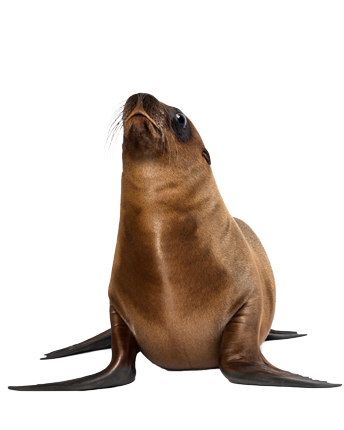
The California sea lion (Zalophus californianus) is a pinniped mammal species from the otariid family that lives along the Pacific coast from Canada to the Baja California peninsula in Mexico.

Characteristics
Behavior, Diet, and Habitat
Interesting Facts
Characteristics
California sea lions (Zalophus californianus) display marked sexual dimorphism: males weigh between 300 and 380 kg and reach about 2.4 m in length, while females weigh only 80 to 120 kg and measure between 1.8 and 2 m. Adult males have a pronounced sagittal crest, which gives them a distinctive appearance and aids in territorial and mating battles.
They have a streamlined body with a layer of blubber beneath the skin that provides warmth and buoyancy. In addition to this blubber, they can regulate their temperature using their flippers, which can cool down or warm up to help maintain body temperature. Their coat is a chocolate-brown color. Their large eyes help them adapt to low-light conditions in underwater environments, while their whiskers enhance their sense of touch, allowing them to detect movements and vibrations in the water—essential for hunting in murky or dimly lit conditions.
Their nostrils close automatically upon entering the water, preventing water from entering and enabling them to dive with ease. Their long fore flippers can rotate outward for better movement on land and provide powerful propulsion in the water, where they spend most of their time. These adaptations allow them to move with agility both in the ocean and on land.
They can dive to depths of up to 200 meters and remain submerged for around 20 minutes, thanks to their ability to store oxygen in their muscles and slow their heart rate during dives. This ability enables them to explore a wide range of underwater habitats and access diverse food sources.
Behavior, Diet, and Habitat
ChatGPT Plus
Sea lions feed mainly on fish and mollusks, though they also consume squid and crustaceans. They are highly social animals, often found in large groups on cliffs, coastlines, and even on docks and navigation buoys. Sea lions are very playful and curious, frequently interacting with objects and with each other—behavior that is crucial for developing their social and hunting skills.
Males are territorial and maintain harems of around fifteen females each. Mating usually takes place between May and June, and after a gestation period of 12 months, females give birth to a single pup, either on land or in shallow water. They are the only mammals whose milk does not contain lactose—an adaptation that allows them to provide highly energetic and easily digestible nourishment for their young.
They use loud vocalizations, such as barks and growls, to communicate and establish territory. These vocalizations also play an important role in coordinating group activities and in communication between mothers and pups. Sea lions also use physical contact and body postures to reinforce social hierarchies and maintain group cohesion.
They are found along the Pacific coast, from southern Canada to central Mexico, occupying a variety of habitats including sandy beaches, rocky shores, and artificial platforms such as docks and buoys. During migration season, they can travel long distances in search of food and shelter. Their ability to adapt to different environments and their varied diet allow them to survive in changing conditions.
Interesting Facts
California sea lions are known for their intelligence and learning ability, which allows them to perform tricks and follow commands in captivity. This skill has been used in zoo and aquarium shows as well as in scientific research on animal behavior and cognition. They are often seen in harbors and marinas, where they have learned to interact with humans and seek food, demonstrating remarkable adaptability and opportunism.
Different subspecies of sea lions exist in various regions, each adapted to specific local conditions. These adaptations may include variations in body size, coat color, and reproductive behavior, enabling them to thrive in a wide range of marine environments.
In the wild, sea lions can live between 15 and 20 years, while in captivity they can reach up to 30 years due to the absence of predators and constant food availability. Their main predators are orcas and great white sharks, which pose a significant threat, especially to young and inexperienced individuals. Pups can also be vulnerable to birds of prey and other marine mammals.
The ability of sea lions to learn and remember complex tasks has been documented in several studies, and they have been shown to use tools and solve problems, suggesting a high level of intelligence. In some cases, sea lions have been observed using cooperative hunting techniques, where multiple individuals work together to corral and capture prey, increasing their efficiency and success in obtaining food.
In addition to their role in the marine ecosystem, sea lions have also been used in animal-assisted therapy programs due to their friendly nature and ability to interact positively with humans. Their presence in coastal ecosystems also significantly impacts fishing communities, as they compete for the same resources and, in some cases, may cause conflicts with local fishermen.

You can find them in...
Learn more...
What are the differences between seals and sea lions?
16 August, 2019
No Comments
Most people tend to confuse sea lions with their distant relatives: seals. Although they may seem similar at first sight, we are going to explain what the most significant differences