

Southern Lapwing
Species
Vanellus miles
Order
Charadriiformes
Family
Charadriidae
Conservation status
Low risk (Least Concern)
Vanellus miles, commonly known as the masked lapwing or spur-winged plover, is a bird species belonging to the family Charadriidae, which includes lapwings and plovers.
It is native to Australia, Tasmania, New Guinea, and some nearby Pacific islands. The species has expanded its range into urban and suburban areas.
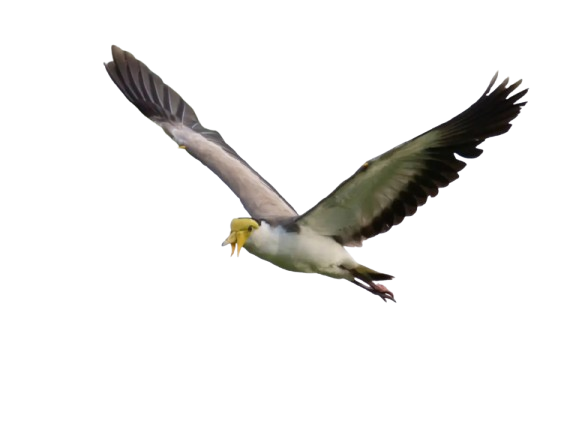

Vanellus miles, commonly known as the masked lapwing or spur-winged plover, is a bird species from the Charadriidae family, which includes lapwings and plovers. Measuring approximately 35 to 38 cm in length, it is the largest representative of the Charadriidae family. This species stands out for its white plumage on the chest and face, which contrasts elegantly with its olive-brown back and darker wings. Both sexes look very similar, with minimal differences, and their silhouette is unmistakable in the open, wet habitats where they are commonly found.
One of the most distinctive features of the masked lapwing is the yellow “mask” that surrounds its bill and eyes, formed by a loose wattle of skin, along with a fleshy yellow extension that hangs like a “spur” or “thorn” on the face. This unusual facial ornament gives it a unique and easily recognizable appearance, serving both as a visual signal among individuals and as a deterrent against potential threats.
The masked lapwing is a bird native to Australia, easily recognizable by its yellow facial wattle and large size. It prefers wet habitats such as lakes, lagoons, and low grassy areas, but has adapted remarkably well to human-modified environments like parks, urban gardens, golf courses, and even rooftops or parking lots. This adaptability allows it to thrive in both natural and urban settings, as long as it can find open ground for nesting and foraging.
During the breeding season, the masked lapwing becomes highly territorial, defending its nest aggressively by emitting loud alarm calls and performing low, swooping flights to drive away potential threats — even using distraction tactics to mislead predators. Their nests are always built on the ground, often in open and unusual places. Both parents care for the eggs and chicks, which remain under family protection for an extended period.
In terms of diet, the masked lapwing is primarily omnivorous, though it feeds mostly on insects, worms, and small invertebrates, which it finds by walking and foraging on the ground. It also consumes seeds, leaves, and occasionally mollusks and crustaceans. It tends to feed both during the day and at night, taking full advantage of the available resources in its environment.
The masked lapwing exhibits remarkable traits in both reproduction and conservation, highlighting its uniqueness within Australian birdlife. This species is monogamous and highly faithful to its nesting site, where both parents actively incubate 2 to 4 eggs laid directly on the ground, typically in shallow depressions covered with low grass or nearby vegetation, often near water. The chicks are precocial, meaning they are able to walk shortly after hatching and remain under the protection of their parents for several months, until they are developed enough to fend for themselves.
In terms of conservation status, the masked lapwing is classified as “Least Concern” by the IUCN, as it faces no significant global threats and has successfully expanded its range, including into urban and suburban environments. However, during the breeding season, its aggressive territorial behavior can sometimes lead to conflicts with humans, especially in urban areas where it fiercely defends its nests. This combination of adaptability and active parental care makes it a fascinating species, capable of coexisting alongside human communities without losing its instincts and survival strategies.
In short, the masked lapwing stands out not only for its distinctive appearance and habitat, but also for its surprising reproductive behaviors and its ability to adapt to a wide range of environments, maintaining stable populations and expanding into human-modified regions. Its role in the ecosystem and interaction with humans make it an important subject for both conservation efforts and the study of Australian wildlife.