

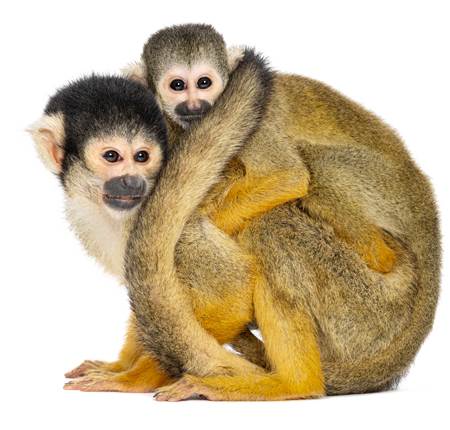
The common squirrel monkey (Saimiri sciureus) is a Neotropical primate belonging to the Cebidae family. Like all squirrel monkeys, it has a long, non-prehensile tail with a black tip. In adulthood, its body measures around 72 ± 10 cm from head to tail and weighs between 0.55 kg and 1.25 kg. It is characterized by a white facial mask on its face, with a black (or dark brown) muzzle standing out. Like Saimiri oerstedii and Saimiri ustus (and unlike other species of the genus), its facial mask forms a “gothic” arch above the eyes, creating a white V-shape.
Squirrel Monkey
Species
Saimiri sciureus
Orden
Primates
Familia
Cebidae
Conservation status
Low risk (Least concern)

Characteristics
Behavior, Diet, and Habitat
Interesting Facts
Characteristics
Squirrel monkeys form the largest groups of any Neotropical primate species. Groups of 25 to 45 individuals have been observed, with significant variations depending on the habitat they occupy. These groups consist of multiple males and multiple females; reports indicate approximately 65% infants or subadults, 29% adult females, and 6% adult males.
A study conducted under captive conditions in Florida found that groups tend to divide into male and female subgroups, with stronger cohesion within the female group (represented by closer physical proximity). The study also noted the presence of strict linear hierarchies within both the male and female subgroups, though the hierarchy was much more evident among males.
Behavior, Diet, and Habitat
Their distribution range extends from central and northeastern Brazil to the western Andes in Peru, Ecuador, and Colombia, and also includes Venezuela, Guyana, French Guiana, and Suriname. Their current population size is unknown. They can be found in a wide variety of habitats and even survive in remnant forests in areas where human activity has altered the natural environment, as long as there is enough fruit and insect supply. Being diurnal, they form groups that, depending on the environment, can range from 10 to about 50 individuals, all composed of several males, several females, juveniles, and infants. They are not highly territorial and generally avoid conflict when encountering other groups.
Because of their ability to survive in human-altered environments, they are not considered threatened. However, hunting for the pet trade remains a significant threat to the species.
Studies on Saimiri sciureus describe it as a primarily frugivore-insectivore species. They feed on fruits, berries, nuts, flowers, shoots, seeds, leaves, gums, insects, arachnids, and small vertebrates. However, their digestive tract is relatively short, making them better adapted to digest insects than plants.
In general, squirrel monkeys tend to forage for and consume mostly fruit in the early morning, gradually shifting toward preferring insects as the day progresses.
Interesting Facts
La gestación dura unos cinco meses y medio, tras los cuales nace una única cría. Durante la época de cópulas es común la acumulación de grasa en los machos, especialmente alrededor de los hombros. Las primeras dos semanas las crías permanecen durmiendo, alimentándose principalmente con su madre. A partir de 2 – 5 semanas de vida empiezan a separarse de la madre y a ser cargados por otros miembros del grupo. Los jóvenes son destetados a los seis meses.
