

Endangered (Threatened)
Sun Parakeet
Species
Aratinga solstitialis
Order
Psittaciformes
Family
Psittacidae
Conservation status
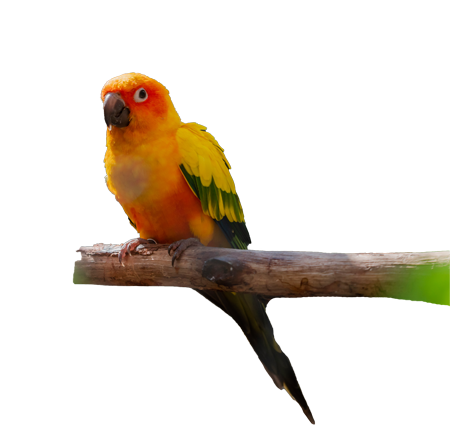
The Sun Parakeet or Sun Conure (Aratinga solstitialis) is a species of parrot (order Psittaciformes) belonging to the family Psittacidae. It originates from South America, ranging from northern to southern Brazil.

Characteristics
Behavior, Diet, and Habitat
Interesting Facts
Characteristics
Young specimens predominantly display greenish plumage (the distinctive yellow, orange, and reddish tones on the tail, abdomen, and head appear with maturity). They do not exhibit sexual dimorphism. They measure between 17 and 30 cm, weighing around 120 g. These birds have a strong, curved beak, well-suited for cracking seeds and fruits. Their legs are robust and adapted for climbing, which is essential for their arboreal lifestyle. Their eyes are large and expressive, with a white eye-ring that accentuates their gaze. As they mature, their plumage becomes increasingly vibrant, with golden yellow tones on the body and bright orange on the face, contrasting vividly with their green and blue flight feathers.
In addition to their colorful plumage, Sun Parakeets have an aerodynamic body structure that allows them to perform fast and agile flights, crucial for evading predators and moving efficiently between trees in search of food. Their feet, besides being strong, are equipped with sharp claws that allow them to firmly grasp branches and skillfully manipulate objects. This ability is vital not only for feeding but also for social interaction and play.
The beaks of Sun Parakeets are not only strong but also extremely precise, enabling them to crack the hardest shells of seeds and nuts with ease. Their thick, muscular tongue helps them manipulate food and extract the necessary nutrients. The combination of their brilliant plumage, body structure, and physical adaptations makes them one of the most distinctive and admired parrot species.
Behavior, Diet, and Habitat
They feed on all kinds of fruits and small seeds. In their natural diet, they may also include flowers, buds, and occasionally insects. They are very social birds and live in flocks in the wild, where social cohesion is essential for protection against predators and for locating food. In captivity, it is important to provide them with a varied diet that includes fresh fruits, vegetables, and a high-quality seed mix. Their natural habitat includes tropical and subtropical forests of South America, where they are found in lowland areas, often near water sources. They prefer areas with abundant vegetation where they can find food and shelter. In urbanized areas, they have adapted to parks and gardens, where they find both food and safety.
Sun Parakeets are known for their highly social behavior and their tendency to form large, noisy flocks. These flocks not only provide protection against predators but also make it easier to locate food sources. In the wild, these birds spend much of the day foraging for ripe fruits, seeds, and flowers, and they are often seen grooming each other, which strengthens social bonds within the group.
In captivity, these birds require a considerable amount of environmental enrichment to remain healthy and happy. This includes not only a varied diet but also toys, perches of different sizes and textures, and ample space for flying and climbing. Daily interaction with their caretakers and with other birds is crucial to prevent boredom and frustration, which can lead to destructive behaviors.
Interesting Facts
These birds are very domestic and often breed easily both in the wild and in captivity. Pairs usually stay bonded for life. They lay between 3 and 5 eggs, with an incubation period of 24 days. In most cases, three of the four or five eggs hatch, and even first-time parents are generally very successful in raising all their chicks. Sun Parakeets are well-known for their ability to form strong social bonds both with their own kind and with humans. They are very vocal and enjoy communicating with their companions through a variety of sounds. Their playful and active nature requires plenty of mental and physical stimulation, so in captivity they benefit greatly from toys and opportunities to climb and fly.
In addition, these birds are known for their intelligence and natural curiosity. They can learn to perform tricks and solve simple puzzles, demonstrating advanced cognitive abilities. This trait, combined with their affectionate nature, makes them popular among bird enthusiasts as pets.
The courtship process of Sun Parakeets includes a series of rituals such as mutual feeding and grooming, which strengthen the pair bond. Once the eggs hatch, both parents actively participate in raising the chicks, providing them with food and protection. Although the chicks are born helpless, they grow quickly and develop their colorful plumage as they approach independence.
In the wild, these birds also play a crucial role in seed dispersal, helping to maintain the health and biodiversity of their ecosystems. By feeding on fruits, Sun Parakeets disperse the seeds of the plants they consume, aiding in forest regeneration and contributing to the tropical forest’s life cycle.
The longevity of these birds in captivity can be remarkably high, sometimes reaching up to 30 years with proper care. This highlights the importance of providing them with an enriched and socially stimulating environment, as their well-being greatly depends on the quality of their surroundings and social interactions.