

White Cockatoo
Species
Cacatua alba
Order
Psittaciformes
Family
Cacatuidae
Conservation status
Endangered (EN)
The white cockatoo (Cacatua alba), also known as the umbrella cockatoo or white-crested cockatoo, is a parrot species endemic to the northern Moluccan Islands in Indonesia. Its beauty, intelligence, and social behavior have made it one of the most popular cockatoos, although it also faces serious threats in its natural habitat.
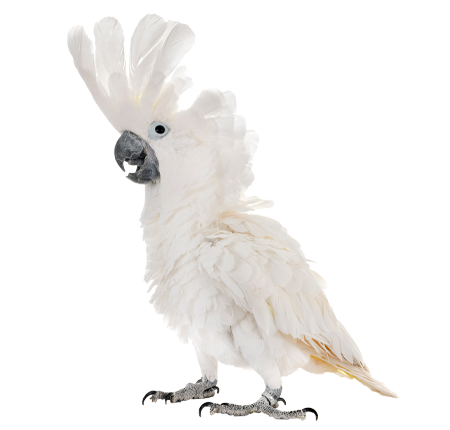

The white cockatoo measures around 46 cm in length and weighs approximately 500 g (females) to 640 g (males). Males usually have a broader head and a larger bill than females. They have brown or black eyes and a dark gray beak. As they mature, all female white cockatoos may develop reddish-brown irises, while the adult male’s iris remains dark brown or black.
As its name suggests, its plumage is mostly white, with a yellowish coloration on the underside of the wings and tail.
Like other cockatoos and parrots, the white cockatoo has zygodactyl feet (two toes facing forward and two backward), which allow it to grasp objects with one foot while perching with the other, useful for feeding and manipulating items.
They feature a large white erectile crest, which unfolds into a semi-circular shape, along with a dark gray beak.
Their lifespan in the wild is around 30 years, while under human care it ranges from 40 to 60 years, with reports of some individuals living over 70 years.
They inhabit lowland tropical forests, mangroves, and plantations on the islands of Halmahera, Bacan, Ternate, Tidore, Kasiruta, and Mandiole in Indonesia. Introduced populations have also been recorded in Taiwan.
Their diet is omnivorous, including seeds, fruits (such as papaya and durian), nuts, roots, insects, and larvae. At times, they may feed on crops such as corn, which has caused conflicts with local farmers.
They are highly social birds, usually living in pairs or small groups. They are very vocal and can produce a wide variety of sounds to communicate.
The nest is built in natural tree cavities. Their eggs are white, usually two per clutch. During the incubation period, which lasts about 30 days, both the female and the male take turns incubating the eggs. The first-hatched chick becomes dominant over its younger sibling and receives more food. The chicks leave the nest about 90 days after hatching and become independent at 3.5 to 4 months. Juveniles reach sexual maturity at 5–6 years.
Its large, fan-shaped crest is not only an aesthetic trait but also serves as a visual means of communication, expressing emotions such as excitement, fear, or curiosity.
These are extremely intelligent birds that require constant mental stimulation. Under human care, if they are not provided with enough interaction and enrichment, they may develop destructive or self-harming behaviors, such as feather plucking.
Regarding their relationship with humans, due to their affectionate nature, they can form very close bonds with their caretakers, even perceiving them as part of their social group.
It is believed that during the Tang dynasty in China, white cockatoos were popular and associated with religious figures such as Guan Yin, the goddess of compassion, who was often depicted with a white parrot.
