

Yellow-crested Cockatoo
Species
Cacatua sulphurea
Order
Psittaciformes
Family
Cacatuidae
Conservation status
Critically Endangered (CR)
The yellow-crested cockatoo (Cacatua sulphurea) is one of the most threatened species in its family. Its population has declined drastically in recent decades, with estimates of fewer than 2,500 mature individuals remaining in the wild. The main threats include capture for the pet trade and the destruction of its natural habitat.
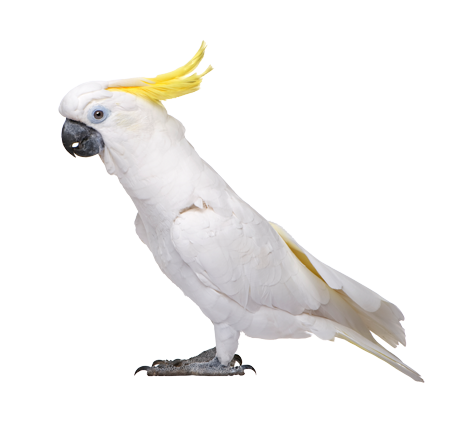

It is a species of bird in the cockatoo family and a member of the genus Cacatua, currently facing severe risk of extinction.
Its size is approximately 34 cm in length. It usually has white plumage and a yellow crest on its head that curves forward. The undersides of its wings and tail are also yellow, its beak is black, and its legs are gray. Females have reddish-brown eyes, while males have black eyes. The skin around the eyes is bluish. Juveniles have gray irises, and chicks hatch with patchy yellow down. The difference between males and females is minimal, as they are very similar in appearance.
It inhabits tropical forests, shrublands, and agricultural areas. It is endemic to East Timor and Indonesia (the Lesser Sunda Islands and Sulawesi).
In the wild, they are friendly and peaceful. These birds live in small flocks or pairs, sometimes gathering in large groups when feeding. They are noisy and often produce harsh screeches, although they are also capable of emitting softer whistles. They are active and energetic birds, playful and gentle, with a tendency to be shy.
The yellow-crested cockatoo feeds on a wide variety of foods, including seeds, berries, nuts, fruits, and flowers. They sometimes raid rice and corn crops, and may also eat green plant material. Through their diet, yellow-crested cockatoos contribute to seed dispersal.
They are monogamous birds, with pairs staying together for life. On Sumba Island, breeding takes place from September to May. These birds nest in tree cavities, laying 2 to 3 white eggs. Incubation is shared by both the male and the female, lasting about 28 days, and the chicks leave the nest at around 75 days old.
In 2007, its population was estimated at fewer than 7,000 individuals, with the largest numbers concentrated on Sumba Island. The decline of this species became particularly pronounced during the 20th century, due to indiscriminate capture for the pet trade. Deforestation of its habitats has further contributed to its decline.
Although commercial capture has been banned since 1994, illegal hunting still continues today, and has been the main cause for the disappearance of this cockatoo from some islands where it once lived.

